

The Big Picture
What to care about this week: NASA launches their second deep-space telescope in five years, a retrospective on global lunar progress, decentralized spacecraft collision avoidance, generative AI CubeSat design, and a rocket survives a lightning strike during ascent.
Also, a retraction from our first edition.
Hubble’s Big Sister, Launching This Month
Where Did She Come From?
In the early 2010s, the U.S. National Reconnaissance Office (NRO) made a few too many spy satellites.
They offered the surplus hardware, two telescope mirror systems designed for orbit, to NASA, who at the time were planning a project with a similar primary mirror. Similar, but much smaller. This gift nearly doubled the size of the developing spacecraft and significantly enhanced its imaging capability.
The donated mirrors were 7.9 feet in diameter, the same size as Hubble’s and far more advanced thanks to the intervening decades. Paul Hertz, the then director of NASA’s Astrophysics Division, described “about [a] 100 times bigger area that you can image well.”
Even with the new hardware, NASA would still have to create all of the systems that support the optical components.
Fast-forwarding through three presidential administrations worth of design, integration, and test yields the Nancy Grace Roman Space Telescope.
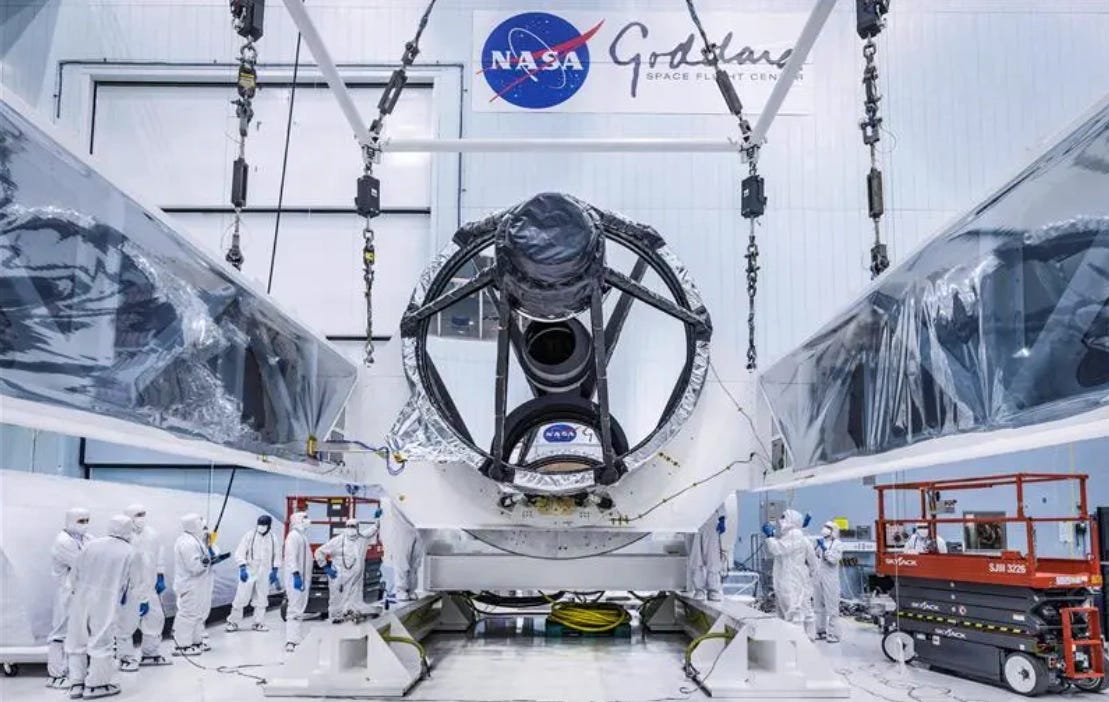
The observatory is named for NASA’s first ever Chief Astronomer. Dr. Roman took the position only 6 months after NASA was founded, and spearheaded the creation of its space-based astronomy program. She championed Hubble’s value when it was just a twinkle in NASA’s eye.
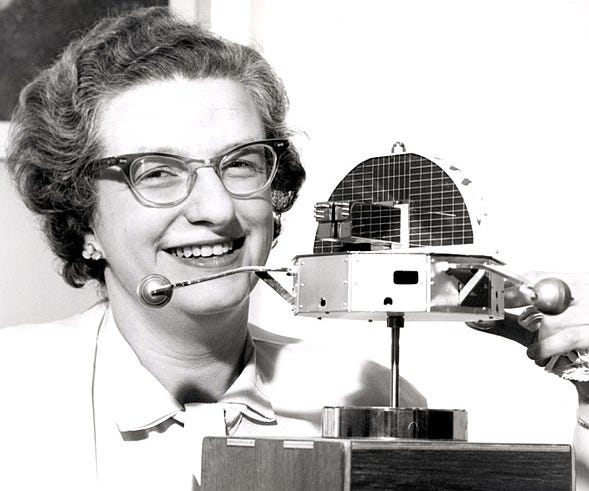
“I certainly did not receive any encouragement. I was told from the beginning that women could not be scientists.” - Dr. Nancy Grace Roman
Such a prolific namesake deserves an equally prolific mission. Roman features two instruments on board, both of which contain the potential for grand discovery.
Besides sounding like my approach to homework in college, the Coronagraph instrument will enable imaging of exoplanets that we don’t yet know exist. It’s the first Coronagraph in space to contain moving mechanical components that can adjust to decrease the starlight captured by the instrument, allowing it to see planets almost a billion times fainter than their host star.
This coronagraph is also an engineering pathfinder, paving the way for development of the Habitable Worlds Observatory, which will require an instrument 100x more effective at masking stars.
Also on board is the Wide Field Instrument, an infrared camera sensitive enough to see farther than any previous telescope.
Because light does not travel instantaneously, the farther away you gaze, the older the image that you receive will be. The Wide Field Instrument will allow researchers to gaze back in time and observe how the universe has expanded throughout history.
The camera has 18 detectors which can capture a maximum 4096 x 4096 resolution apiece. Each image will require massive bandwidth to beam home, and each image will look absolutely stunning.
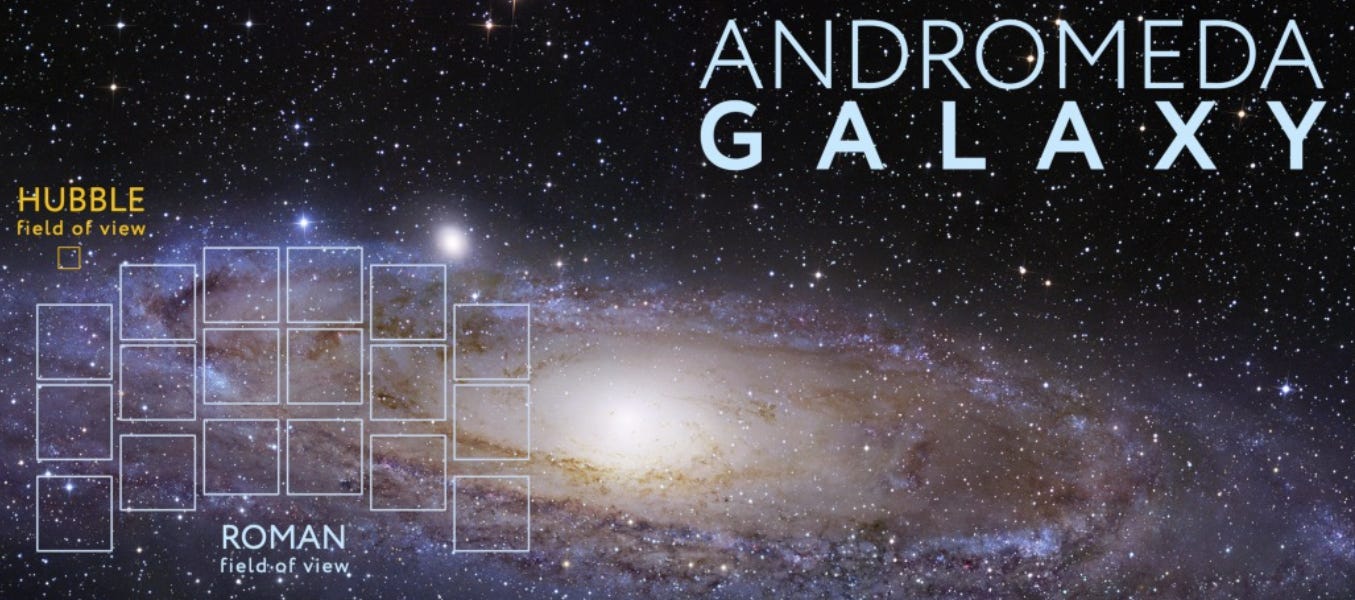
Commissioning of the system in orbit is planned to take 90 days, after which it can begin making observations long before reaching its destination.
This December, be ready to update your desktop background!
Where Will She Go?
On (no earlier than) August 30th, Roman will be launched on a one million mile journey away from the Earth. A distance so great, it requires the 13th ever launch of the Falcon Heavy system.
Why? Putting telescopes in deep-space sidesteps a lot of problems faced by those on Earth and in its orbit.
The Earth has a pesky habit of getting between telescopes and their targets. It also regularly separates solar panels from the sun - and even if you cleverly dodge it with a specific sun-synchronous orbit, glare from the Earth will still blind and heat up sensitive instrumentation. Think of the tanning reflectors that cartoon characters always unfold at the beach.
But our planet isn’t the only thing in the way.
Radio telescope observations and artsy iPhone long exposure shots alike are being increasingly obstructed by satellites. The biggest offender: internet megaconstellations.
SpaceX Starlink, Amazon Leo, Eutelsat OneWeb, China SatNet’s Guowang; all of these projects are taking a ‘the more, the merrier’ approach to satellite design. SpaceX alone owns roughly two-thirds of all active satellites, with over 10,000 operational units in orbit as of writing. I’ll break down all of the current and planned swarms by the numbers in a future edition.
One of the many consequences of this approach is its effect on astronomy, hindering stellar observation with bright trails and false positives.
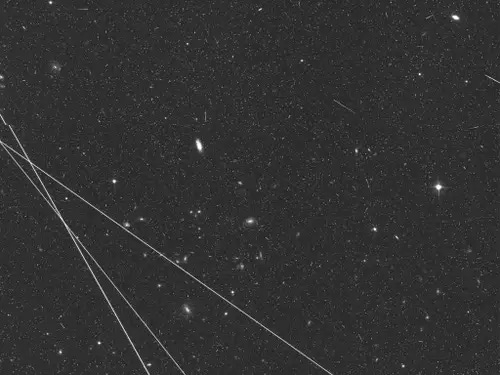
Hubble currently orbits 326 miles above Earth’s surface - roughly the distance between Baltimore and Boston. Even up there, no one is safe from a bug on the lens.
Finally, a topic that is all too often overlooked, the ideal spots to plant a giant telescope tend to be sites of great cultural significance.
For example, Maunakea is the site of 13 active telescope facilities, with another one - controversially - planned. Maunakea is also deeply sacred to native Hawaiians, “symbolic of the piko (umbilical cord) of the island-child, Hawaiʻi, and that which connects the land to the heavens.” (Kepa Maly and Onaona Maly, 2005).
Humanity has been gazing into the stars since long before the invention of the telephoto lens.
This is a gross oversimplification, of course. If you’re interested in learning more about the fraught relationship between astronomy and colonialism, Dr. Fatima Abdurrahman has an excellent (3 hour) deep dive on the subject.
All of these challenges can be avoided with a quick jaunt to the second Sun-Earth Lagrange Point (L2), which is Roman’s destination. The James Webb Space Telescope is also at L2, so she’ll be in good company.
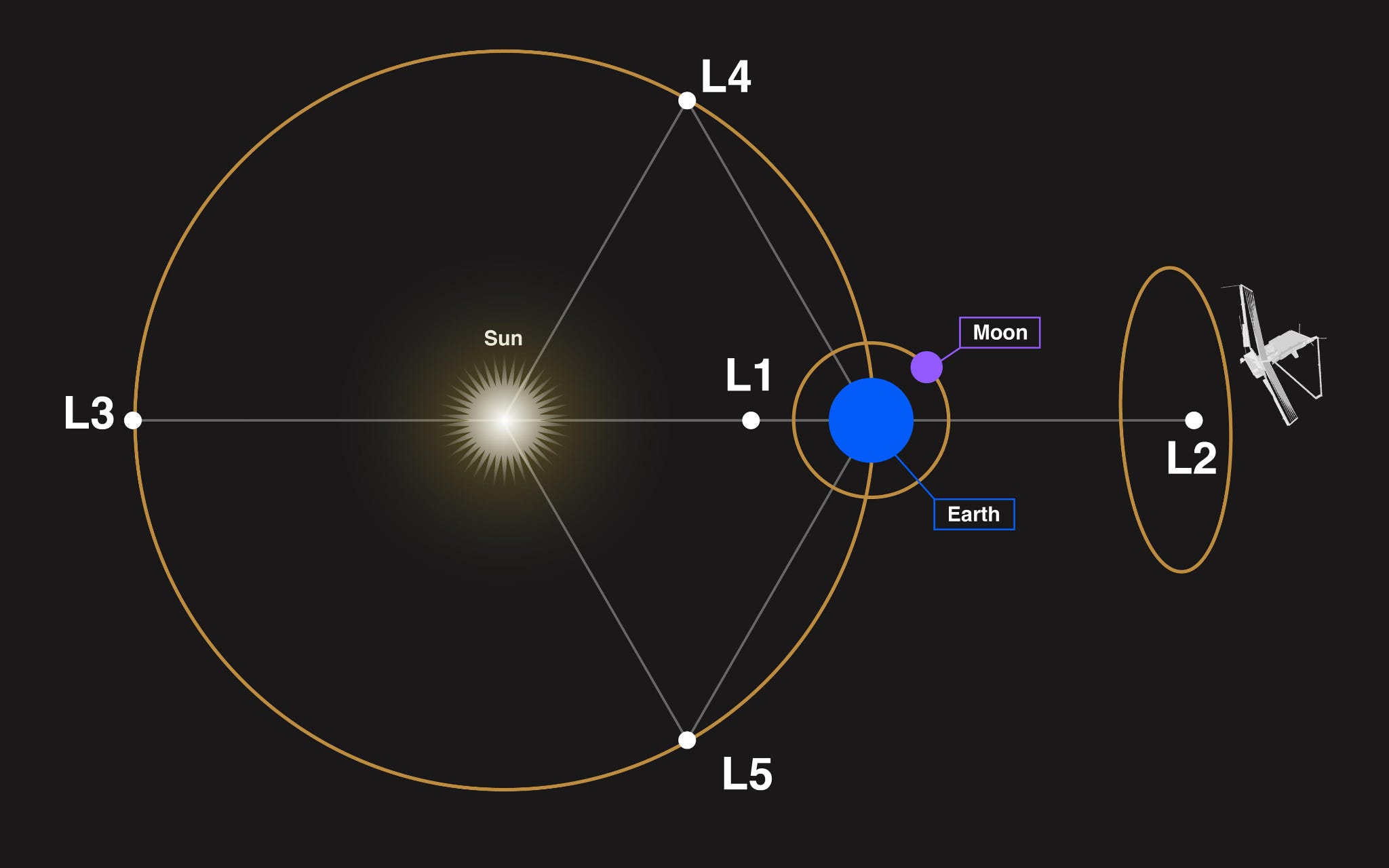
She’ll also be kept company by the 1,350,144 names installed on a memory card as part of an onboard commemorative plaque. Because this mission is worth commemorating!
Roman is the second major deep-space telescope to launch in only 5 years. The assembled spacecraft was completed under budget and ahead of schedule, an impressive feat for a non-military government aerospace project.
Roman represents our human investment in exploring the universe, our rapid innovation in imaging technology, and the redemptive transformation of hardware built for espionage into hardware used for discovery.
I find that deeply meaningful. I hope that you do too.
— — —
…Because I lack restraint, I have to conclude this article by completing the pattern set up by the section headings. Thank you for reading.
Where Did She Come From, Nancy Grace Ro’?
Interesting Links and Papers
Jatan Mehta published a semi-annual retrospective on global lunar exploration milestones and delays, analyzing payload integration bottlenecks, public-private lander architectures, and timeline shifts across Artemis, ESA Moonlight, and Chang’e missions.
Researchers demonstrated using generative AI tools to optimize CubeSat chassis structural design, achieving mass reduction while maintaining modal frequency and thermal dissipation bounds for astronomical payloads.
A new study proposes a semi-decentralized multi-spacecraft collision avoidance architecture, reducing ground-station contact delays by enabling onboard autonomous trajectory renegotiation for megaconstellation maneuvers.
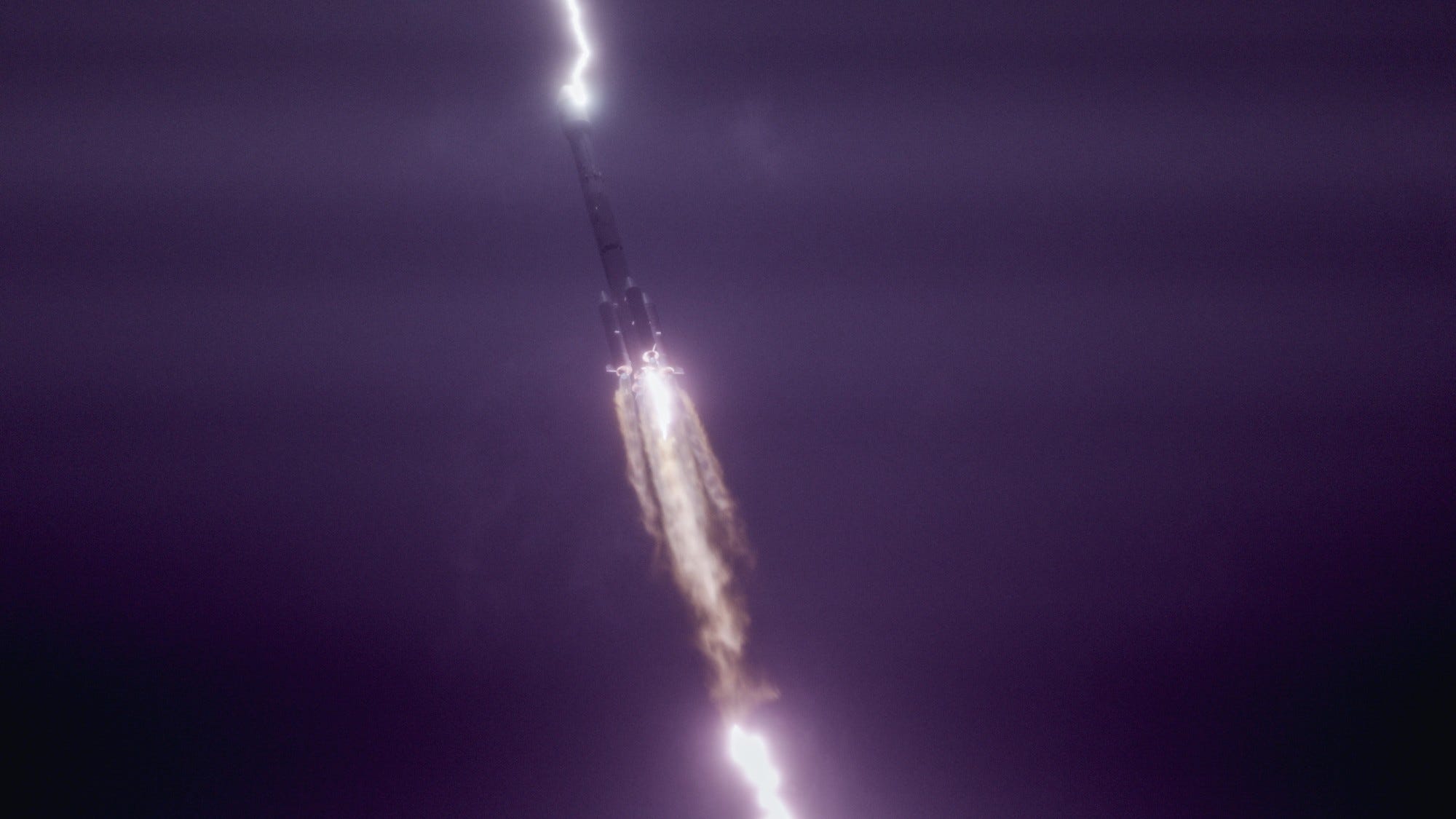
A Chinese Long March 3B rocket was struck mid-ascent by lightning shortly after launching from Xichang Satellite Launch Center, yet successfully delivered its communications payload to orbit.
Upcoming Launches (Sunday, August 9 – Sunday, August 16, 2026)
SpaceX Falcon 9 | Starlink Group 10-15
Target Date / Location: Monday, August 10, 2026 — 06:12 UTC | Cape Canaveral SFS (SLC-40), FL, USA
Details: Starlink.
CASC Long March 3B/E | Geostationary Telecom Payload
Target Date / Location: Wednesday, August 12, 2026 — 16:30 UTC | Xichang Satellite Launch Center, China
Details: Hypergolic three-stage launch vehicle inserting heavy high-throughput communications payload into GTO.
CASC Long March 6A | Qianfan (Thousand Sails) Group 06
Target Date / Location: Thursday, August 13, 2026 — 10:15 UTC | Taiyuan Satellite Launch Center, China
Details: Solid-booster augmented core stage deploying China’s LEO megaconstellation batch to polar orbit.
SpaceX Falcon 9 | Starlink Group 12-7
Target Date / Location: Friday, August 14, 2026 — 03:00 UTC | Vandenberg SFB (SLC-4E), CA, USA
Details: More Starlink.
Roscosmos Soyuz 2.1b | Resurs-P No.5
Target Date / Location: Saturday, August 15, 2026 — 11:20 UTC | Baikonur Cosmodrome, Kazakhstan
Details: Civil commercial Earth-observation satellite featuring hyperspectral and high-resolution optical sensors.
Rocket Lab Electron | “Look Ma, No Hands” Mission
Target Date / Location: Saturday, August 15, 2026 — 21:00 UTC | Launch Complex 1, Mahia Peninsula, New Zealand
Details: Dedicated rideshare mission deploying synthetic aperture radar (SAR) satellites to 500 km LEO.
SpaceX Falcon 9 | Starlink Group 10-21
Target Date / Location: Sunday, August 16, 2026 — 08:45 UTC | Cape Canaveral SFS (SLC-40), FL, USA
Details: More Starlink.
Space Job Openings
Full-Time
Planet Labs is seeking a Senior Spacecraft Systems Engineer located in San Francisco, CA.
Relativity Space is seeking a Launch Integration Engineer II located in Cape Canaveral, FL.
Rocket Lab is seeking a Propulsion Systems Engineer I/II located in Littleton (Denver), CO.
SpaceX is seeking a Sr. Space Lasers Engineer, Satellites (Starlink) located in Redmond (Seattle), WA.
Vast Space is seeking a Mechanical Engineer I, Avionics (Haven Station) located in Long Beach, CA.
Internships & Co-ops
SpaceX is seeking a Summer 2027 Software Engineering Internship/Co-op located in Redmond (Seattle), WA & McGregor, TX.
Varda Space Labs is seeking a Mechanical Engineering Intern located in El Segundo, CA.
Mea Culpa
In our first edition, I relayed a quote from Bloomberg stating that the Falcon 9 program is halting manufacturing of their second stages. Seeing as those stages are expendable every launch, that has huge implications for the Falcon program and the launch industry at-large.
In the following days, it has become clear that this claim has no basis in reality. Additionally, the authors of the source article have altered the verbiage to be much more vague, with no notes about the edit.
I reached out to a contact of mine who currently works Falcon 9 Second Stage Integration and they denied any winding down of upper stage manufacturing.
I apologize for uncritically parroting misinformation. This newsletter is, by name, predicated on everything I publish being all true. I failed to live up to that in the very first publication.
The friends I’ve made in my career so far are uniquely suited to confirm or deny claims like this. You have my word that from now on, I will lean on my network and ensure everything written here is verified by a credible second source.
I appreciate your grace, I won’t let you down.
I’m Ben Durkee and this is Altru.
Why Altru?
Altru Space is a technical deep dive on the space industry’s top stories, delivered weekly. We emphasize engineering excellence and sustainability to understand how we can make our world a better place and explore our next frontier at the same time.
Thank you for the reminder that Science is still going
Big mirrors in space should point away from, not down onto the Earth.