

SpaceX Freezes Launch Contracts
Earlier this month, SpaceX launched its 17th rideshare mission, successfully deploying a total of 81 payloads from a single rocket. While killing a lot of birds with one stone, this cosmic clown car also heralds the beginning of the end for the Falcon 9 rideshare program, and for future commercial contracts.
Satnews.com reported on Monday that “small satellite operators and mission integrators confirmed that SpaceX has stopped accepting new commercial launch bookings for both its Sun-Synchronous Orbit (SSO) Transporter series and mid-inclination Bandwagon missions beyond late 2028.”
The SpaceX website details only 3 remaining rideshare launches; all of them completely full and all of them scheduled for 2027. Historically, these missions have been scheduled years in advance, so for today’s interested customer not a single spot remains.
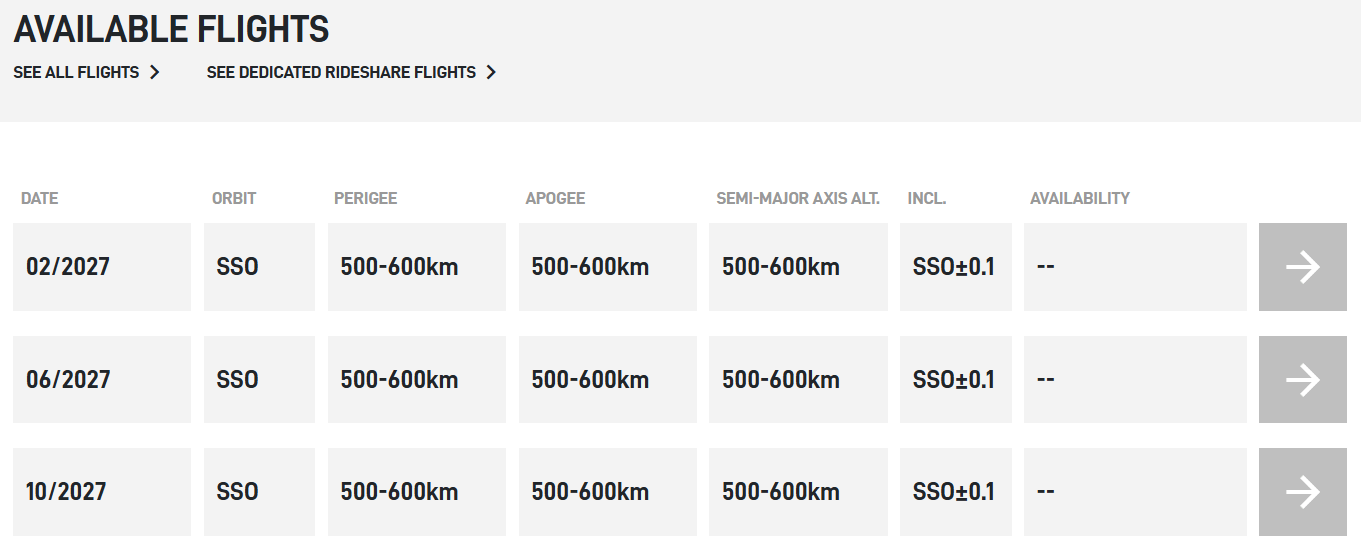
The website also used to have a function where anyone could apply to book a singular launch, boasted proudly on the front page and the site header. Now? The option is gone without a trace.
To be clear, Falcon 9 launches are not freezing - at least not yet. Rather, much like how Micron stopped selling memory to consumers because they make more revenue by selling solely to AI firms, SpaceX is ceasing to serve external clients in favor of scaling up Starship infrastructure and creating their own demand.
SpaceX is not a charity, especially now that they are a publicly traded company, and the profit incentive directs them to bolster their breadwinner: Starlink. In 2025, 75% (123 out of 165) of Falcon 9 launches were dedicated to Starlink missions alone. That’s up from 66% (89 out of 134) of F9 launches in 2024. SpaceX’s biggest customer is SpaceX.
To make a single trip to the moon, Starship’s architecture may require more launches than some entire space programs. But it’s uniquely equipped to deliver a huge mass to Earth orbit, i.e. a swarm of identical satellites or a colossal datacenter, hence the decision to wind down Falcon and go all-hands-on-deck for the new vehicle.
So what does this mean for everyone else? SpaceX’s largest competitor, Blue Origin, is no longer completely owned by Jeff Bezos and co., having just received its first round of outside funding to the tune of $4 billion. Blue also has a series of projects which represent internal1 demand for launches of their New Glenn vehicle, a rival of Starship.
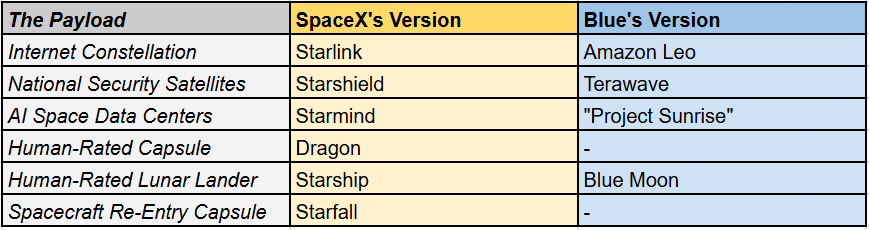
If these companies have their hands full launching their own stuff, that leaves us relying on a couple industry mainstays and the next generation of launch vehicles.
🚀 Rocket Lab’s Electron vehicle remains the only other new-space vehicle with truly mature flight heritage. Their upcoming Neutron vehicle (comparable to Falcon 9 in size) just underwent a successful test of one of its engines.
🚀 United Launch Alliance (ULA) are grizzled industry veterans, but they’re phasing out their proven Atlas V rocket. Its successor, Vulcan, has 4 successful launches under its belt and is scheduled far in advance to be shared between national security payloads and commercial constellation launches (Amazon Leo). So these potentially profitmaxxing payloads are poised to take other rockets off the menu as well.
🚀 Firefly Alpha has yet to stabilize its mixed launch record.
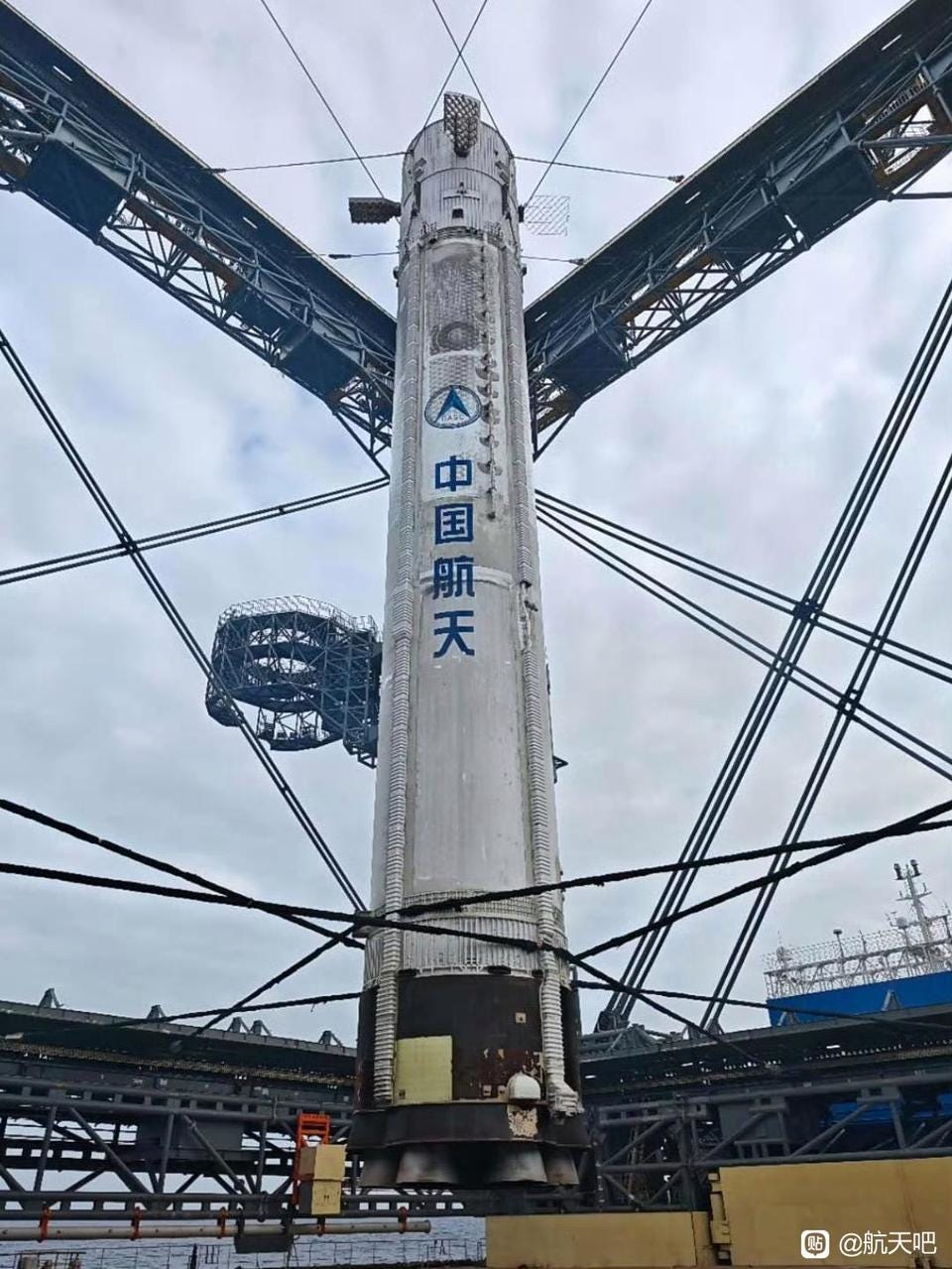
🚀 China’s Zhuque-1 and Long March 10B are in accelerated development - the latter of which just caught its booster with a barge-mounted wire rope assembly.
🚀 Skyroot Aerospace’s Vikram-1 successfully launched last week - on its first try, no less - crowning it India’s first private rocket to reach orbit.
🚀 And there’s a myriad of promising up-and-comers with no successful launches yet. See the footnotes2 for an exhaustive list.
Will these launch vehicles remain accessible to smallsat customers for one-off missions? Or will space internet service providers and AI firms soak up every launch for years to come? How long before Firefly announces a line of AI datacenters and calls it “Hivemind?”
The long-term stability of launch costs is still impossible to predict. We’re privileged to live in a time where rocket supply and demand are both going gangbusters, and we have front row seats to watch the next generation of launch vehicles unfold. Maybe expect a spike in popcorn sales.
In the near-term, the almighty dollar has ushered in an era of high-speed internet and AI chatbots. And while at first glance it may seem bleak, this represents a major vacuum in the market. Research groups, climate institutes, governmental agencies, and satellite startups will still need rockets to launch their products, and having the big dogs bow out of the market creates a feeding frenzy for new rocketeers to take over and propel launch technology forward.
If we’re lucky, this temporary lull is going to precipitate the biggest surge of innovation the launch industry has ever seen. Stay tuned! You won’t want to miss it.
This Week’s Upcoming Launches
July 28, 2200 EDT • Falcon 9 Block 5 • Starlink Group 17-52 • Vandenberg, CA
July 28, NET 0700 EDT • Long March 7A • Unknown payload • Wenchang, China
July 29, NET 2100 EDT • Long March 6A • Unknown payload • Taiyuan, China
July 30, 0309 EDT • Falcon 9 Block 5 • NROL-95 • Cape Canaveral, FL
Aug. 1, 1000 EDT • Falcon 9 Block 5 • Starlink Group 17-53 • Vandenberg, CA
Who, What, & Why is Altru Space?
Hi!
My name is Ben Durkee, and I’m an aerospace engineer and science communicator. In the past, I worked design, integration, & test on Northrop Grumman’s Minotaur rockets and later Firefly’s Blue Ghost 1 lunar lander. Now I work launch operations on New Glenn, Blue Origin’s burgeoning heavy launch system. The very same one that just disassembled its launch pad… so we may have burgeoned a little too close to the sun. There’s never a dull moment in this industry of ours!
Which is why I love to talk about what I do and what’s going on in the space realm. But eyes have begun to glaze over at the Thanksgiving dinner table, so I’m seeking other outlets.
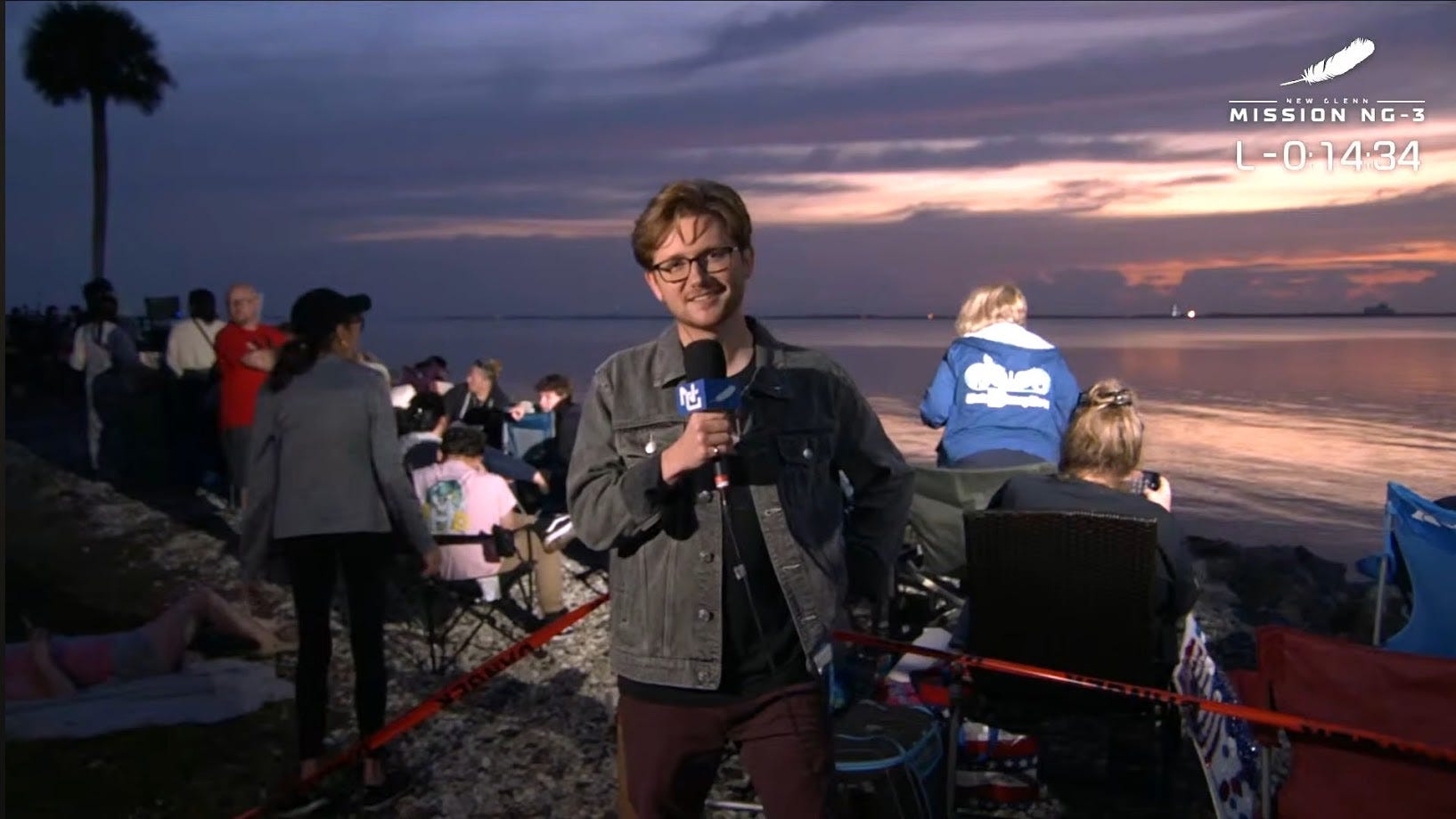
The conflict of interest is visible from orbit. I’m one to err on the side of caution, so if you find that my writing is noticeably hesitant to speculate on Blue Origin’s moves and machinations, please understand that I really like my job.
You have my word that I will develop this publication with the most up-to-date information that I can confirm is publicly available. Inevitably, my work will inform my writing and my writing will inform my work. I intend to use these swords to sharpen each other in the pursuit of absolute quality. Because participating in the space industry is special.
That’s really the crux of the thing! Space is the next frontier, the ultimate unknown that’s worth exploring not for any material or intellectual benefit, but Because It’s There. It inspires and delights and represents hope on a cosmic scale. And now that so much money has entered the scene, our technology and access is about to develop lightning-fast.
But there’s a whole lotta snags that seem to be falling to the wayside. Snags that are eventually going to bite us in the rear; including, but not limited to:
How can we scale up our launch cadence without injecting the atmosphere with greenhouse gases? How do we improve our launch capability without stuffing Earth’s orbit full of satellite constellations? How can we develop a presence on other worlds without paving over paradise? How can we move manufacturing and other polluting industries off-world without exacerbating wealth inequality and making Earth exclusive to the rich?
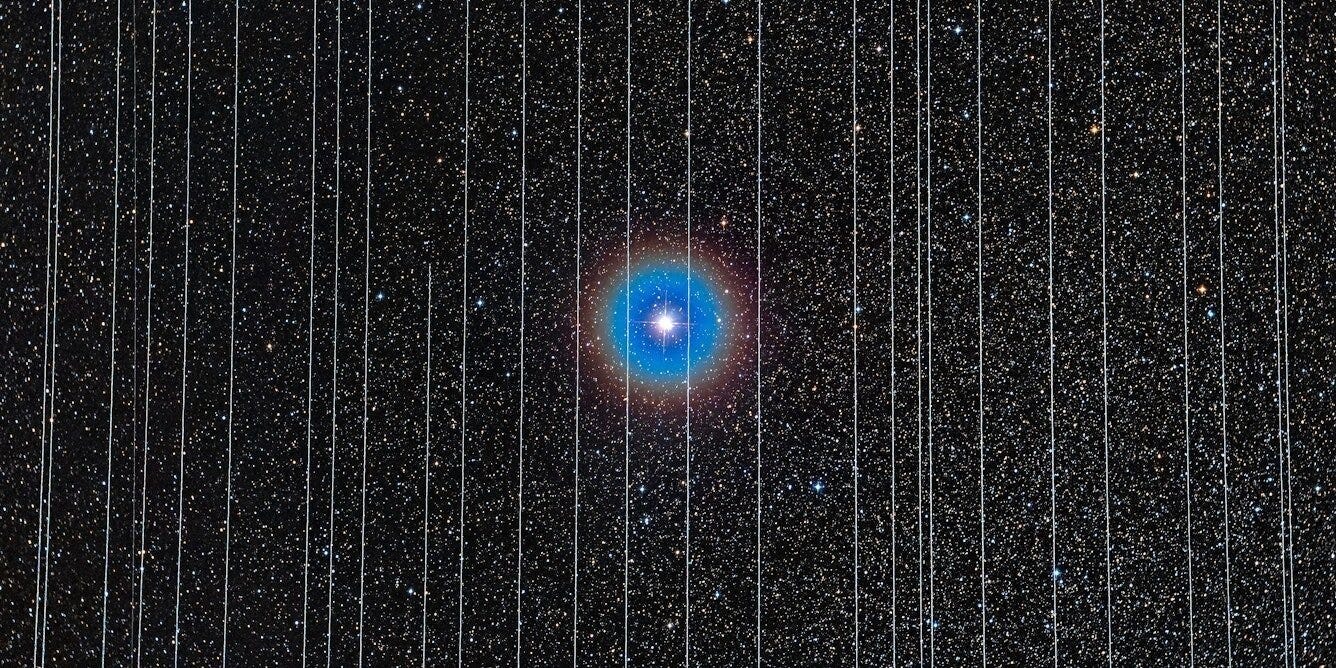
These are heady questions, ones I can really only answer with abstract platitudes, nothing concrete. We need to think and act with care. To be conscientious of our actions and their consequences. To get it right the first time, lest we condemn ourselves to a never-ending game of keepie-uppies.
In an industry moving so quickly - where one of the largest non-nuclear explosions on American soil is nothing but an inconvenient setback - those answers are inadequate. If I want to contribute my skills to this exciting new frontier and help us course-correct towards becoming an altruistic spacefaring people, I’m gonna need a better understanding of all the moving parts and where I can fit in to do the most good.
I’m gonna need a way to get my finger on the pulse, share my unique perspective, and build a network of people smarter than me, all at the same time.
I’m gonna need a newsletter.
So that’s where we are now - the first edition of my desperate attempt to catch a moving train. As we characterize this industry that changes every day, I’m confident that my research, stories, and outlook will provide you with insight you won’t find anywhere else. Together, let’s figure out how we can make the world a better place and launch rockets at the same time.
Be good and please remember: we can’t put humanity in space if we lose our humanity in the process.
I’m Ben Durkee and this is Altru.
Amazon’s Leo constellation is technically not an internal project for Blue Origin, but the companies are so inextricably linked that the end result is the same: control of the entire launch vehicle/payload ecosystem.
Stoke Space’s Nova • Relativity’s Terran R • Northrop Grumman and Firefly’s Eclipse • Astra’s Rocket 4 • PLD Space’s Miura 5 • Orbex’s Prime • Skyrora XL (with ecological fuel!) • Isar’s Spectrum • RFA One • MaiaSpace’s Maia • Gilmour’s Eris Block 1 • Innospace’s HANBIT-NANO • Space One’s KAIROS • Interstellar Technologies’ Zero • Orienspace’s Gravity-2 and Gravity-3 • Space Pioneer’s Tianlong-3 • Galactic Energy’s Pallas-1 • i-Space Hyperbola-3 • Deep Blue’s Nebula-1 and Nebula-2