

The Big Picture
Top of stack: using magnets to protect a craft during re-entry, SpaceX confirms they will be retiring Falcon 9, an engineering student’s open-source fluid model of the Raptor 2 engine cycle, an investor’s post-mortem on three failed space startups, and the physics behind lunar launchpads.
Replacing Heat Shields with Magnets
For your spacecraft to be in a stable orbit, it needs to be moving quick. The closer to the Earth your orbit is, the faster it needs to be going. For a circular orbit at ISS altitude (400 km), you need to be cruising at about 17,160 mph.
For your spacecraft to land gently at home, it needs to be moving slow. To get from orbital speed to none speed requires the expulsion of a lot of kinetic energy in a short time, which tends to make things toasty.
Not to mention that once you’ve slowed down a little, mommy Earth wants to pull your vehicle down faster and faster. The lovely gravity that once kept your spacecraft going round and round is now converting your latent potential energy into kinetic energy. Giving you more speed, more friction, more heat. Not helpful.

In the last edition, we discussed the forerunner technologies your craft may use to survive re-entry, and some mechanical entrants to the field that could shake things up. However, each of those solutions incurs a heavy mass penalty. In spaceflight, a pound of mass can cost thousands to tens of thousands of dollars.
Heat shields can easily account for 15-30% of your craft’s total dry mass. And it’s completely dead mass that is bolted on and effectively useless until the very end of the mission.
And don’t even get me started on the radio blackout problem.
Too late, I’m started!!
The friction that slows your vehicle down heats the adjacent air into a fine plasma. In addition to cooking your vehicle, this plasma likes to act as a Faraday cage around it, so radio signals won’t be getting in or out.
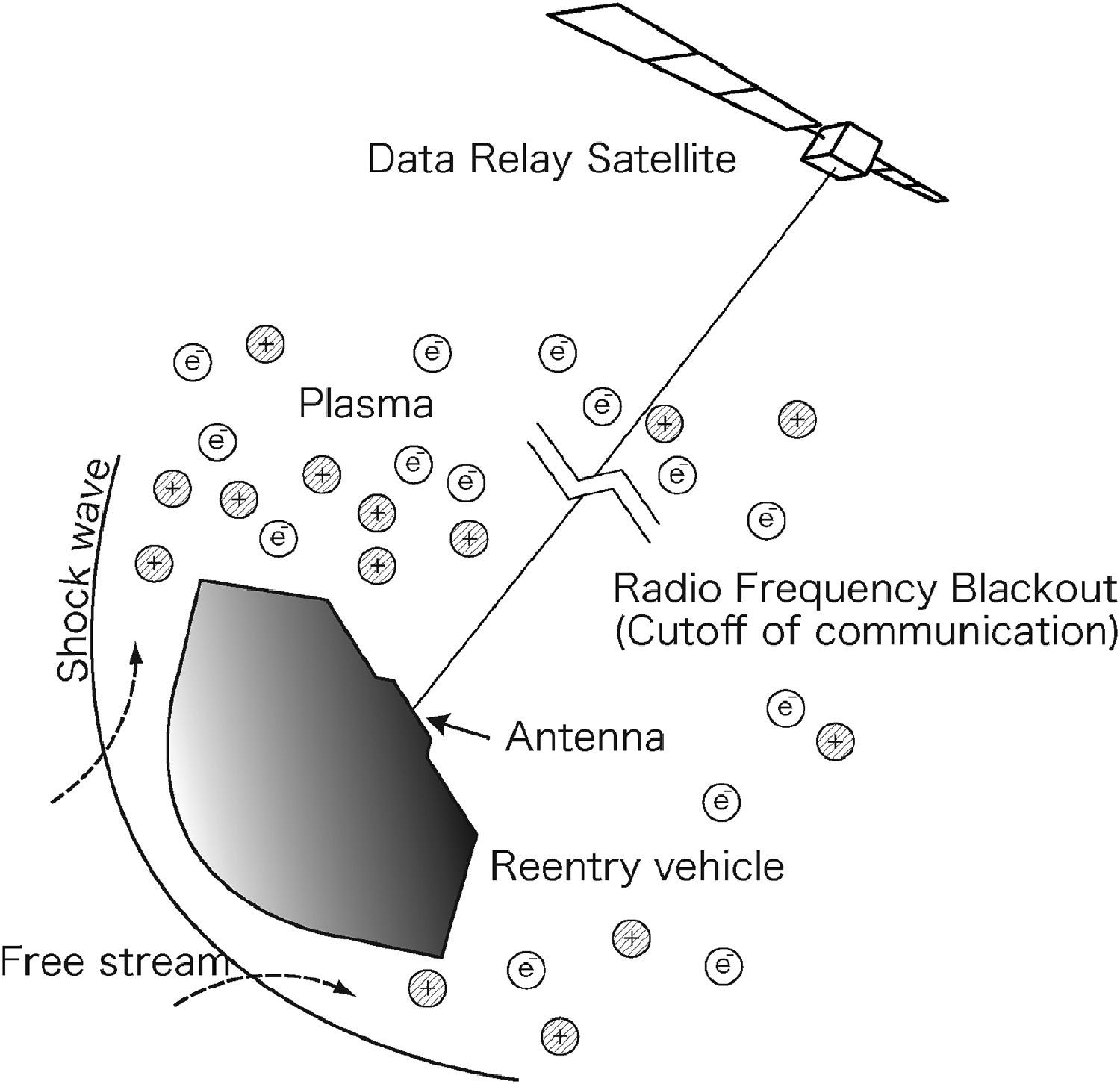
During the most violent and safety-critical phase of the entire mission, your craft is unable to broadcast to the ground or receive commands from it. Complete radio silence. Flight controllers get to squeeze stress balls and chew pens.
Apollo 8’s blackout stretched to over five minutes while its family back on Earth listened to the clock. If something goes wrong, you find out afterward.
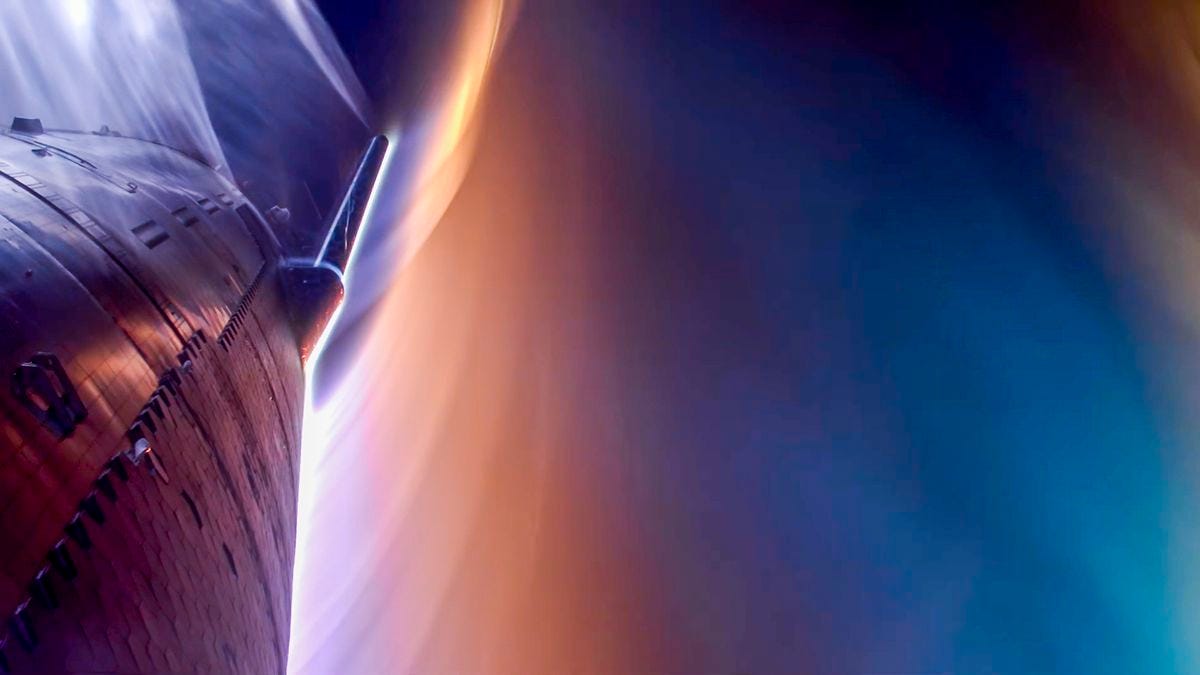
Also, if you want to have a live camera feed from your vehicle like SpaceX does on their launch vehicles (which I encourage everyone to do! I’ll save the diatribe for its own write-up. Put cameras on your craft.), your broadcast is cooked during re-entry. Literally and figuratively.
So, while your craft is plowing through the atmosphere, it is simultaneously being superheated by plasma and unable to communicate with the outside world.
What if we could solve both of these problems… with magnets!
Living Like Lorentz
Let’s talk about magneto-hydrodynamic (MHD) shielding.
While the big, boiling bubble of plasma is the crux of our problem, it also presents our solution. See, plasma is a fluid of charged particles. And charged particles obey electromagnetic fields.
Content warning: equations. Skip ahead a little bit for the physical takeaways.
This is the standard Lorentz force enacted on an individual particle with charge q.
Our players:
F = The resulting deflecting force (Lorentz force)
q = Net electrical charge of particle
E = Any additional electric field in the system (negligible here)
v = Velocity of the charged particle (flow velocity of the plasma)
B = Externally generated magnetic field vector
When scaling this up to a continuous fluid (like our plasma bubble), we transition from individual charge velocity to current density J = nqv (where n is charge carrier density). Ignoring the electric field component (E) yields the simplified form:
The beauty of the thing is, because entry velocity v is massive and J scales with it, the (J x B) cross-product generates an enormous deflecting force perpendicular to the field lines.
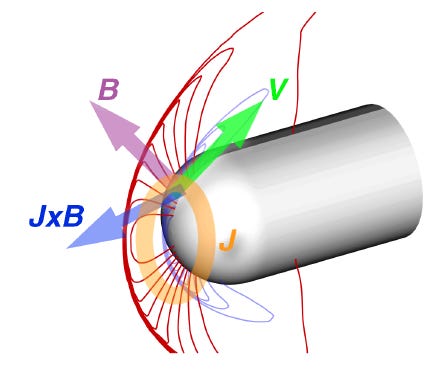
Pay attention to the direction of that (J x B) vector - that’s our resultant force.
Note that this is not a slowing force imparted on the vehicle. All of the slowing comes from the bow shockwave generated by the vehicle slamming into the air. For more information on that force and its implications, check out our previous issue.
Rather, this force is applied to the plasma itself! The magnetic field deflects the plasma, controlling the flow and pushing the shock layer away from the vehicle.
Okay, how does this help?
By pushing away the shock, putting a magnet in your vehicle can keep it cooler and grant it a communication window.
It keeps things cool because the farther away the shock is, the farther the thermal energy needs to travel to reach your craft.
It gets rid of the radio blackout by popping the “bubble.” Deflecting the plasma makes it harder for it to wrap around the backside of your vehicle, so your magnetic field helps you “punch” a hole through the hot air which you can broadcast through to reach your data relay satellite(s) in orbit.
Fancy folks call the backside of a vehicle its ‘leeward’ side.
Effectively, you are using magnets to mimic the radio tunnel that Starship creates just by virtue of being huge.
That’s the theory - killing two birds with one magnet. Does it actually work?
Demonstrating the Tech
While the concept has been studied in US academic and NASA circles for decades, Europe is ahead of the curve on this one.
The MEESST project (Magnetohydrodynamic Enhanced Entry System for Space Transportation) brought together a consortium of universities and research institutes to build the first-ever high-temperature superconducting (HTS) magnetic shielding system.
Their demonstrator is exactly what you’d draw on a napkin: a blunt-nosed probe shape with a cryogenically cooled HTS magnet embedded behind the nose. The magnet is designed to generate a strong magnetic field that displaces the incoming plasma sheath before it can reach the hull.
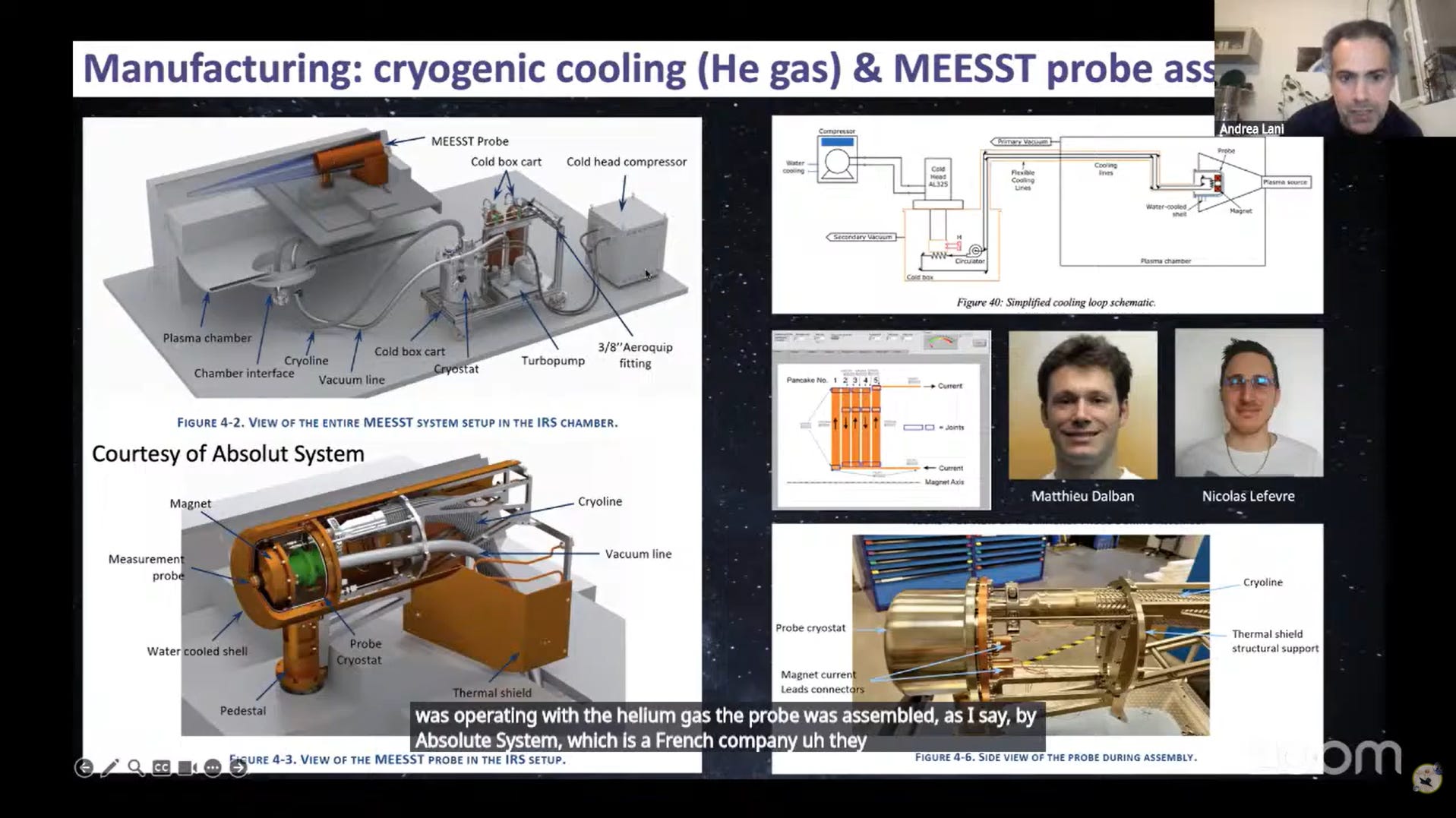
Then, they blasted it with plasma. Specifically, they injected various plasma flows at tightly controlled temperatures and velocities to imitate different re-entry regimes.
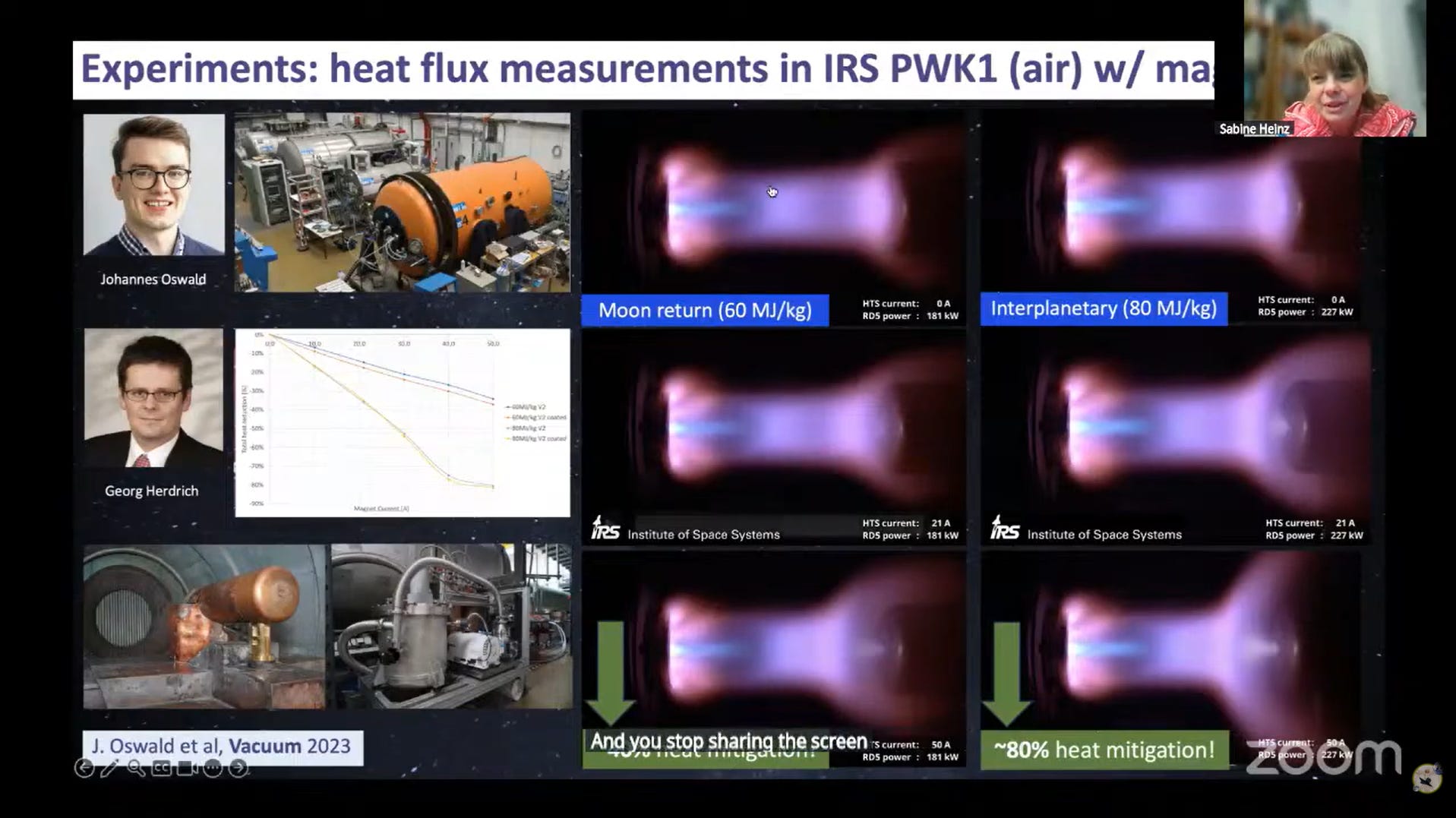
They used two different test beds to accurately measure their mitigation of each re-entry problem. They quantified heat flux in the PWK1 arc jet facility at the Institute of Space Systems and radio blackout in the Plasmatron at the Von Karman Institute. A total of four experimental campaigns were conducted, two for each characterization.
In 2025, the EU published the headline results:
Heat flux mitigation: Great! The magnetic field reduced convective heating on the probe surface by up to 40% for a Moon-return entry (60 MJ/kg) and up to 80% for an interstellar-return entry (80 MJ/kg) in supersonic air plasma.
Radio blackout mitigation: Partial. The MEESST team measured up to 5 dB of signal-loss reduction (a measurable transparency window) in both air and CO₂ plasmas. This effect was weaker than hoped, “suggesting future tests with better antenna positioning, higher (supersonic) flow speed and a higher magnetic field,” per MEESST.
Weight and power: Because HTS coils conduct with near-zero resistance, they generate stronger magnetic fields with dramatically lower mass, volume, and cryogenic power draw than legacy low-temp systems, making the concept compatible with flight hardware constraints. This has engineering implications we’ll talk about in the next section.
So where is MEESST headed? The consortium closed out its grant in September of 2024 and is now scaling the demonstrator toward an actual flight demo, with plans to commercialize via a startup and fly on The Exploration Company’s Nyx capsule.
I love it when a plan comes together - a technology that has been theoretical since the 1960s has finally produced measurable, promising numbers in a test environment.
So why isn’t everyone flying high-temperature superconducting magnets?
Why Must There Always Be Drawbacks
You may have noticed from the picture of the MEESST demonstrator test set that the capsule hardware is only a fraction of the whole setup. The blunt body is dwarfed by its coolant system.
To generate magnetic fields at the level required by this system without melting the copper wires, you need special coils.
Calling them High-Temperature Superconductors is a bit of a misnomer. Older, “Low-Temperature” hardware needed to be kept at 4 Kelvin, which is scraping Absolute Zero. Extremely hard to maintain even in a controlled environment.
High-Temp coils must be kept chilled at cryogenic temperatures near 77 K (-321°F). Compared to Low-Temp, this is positively balmy. Compared to re-entry heating, not so much.
Recall that these frigid temperatures have to be maintained right next to a superheated atmospheric plasma boundary.
Also, to generate a sufficient magnetic field for minutes on end requires discharging stored energy on the order of megajoules.
Battery hardware that can support this level of drain plus coolant hardware to chill the superconductor can chew through the mass you save by ditching ceramic tiles.
And you won’t be able to bank on magnetism guiding a spacecraft all the way to the ground and plopping it down feather-light. The magnetic shielding relies on the existence of the plasma, which stops forming in the lesser hypersonic velocities (Mach 5-10 in the lower atmosphere).
Without the ionized gas in the plasma, the Lorentz force evaporates. There’s nothing left for the magnet to deflect, so by the time you’ve slowed down to supersonic speed, your forcefield has fizzled.
As a result, your blunt body is still gonna need to be able to take some heat - though significantly less. And you’ll still need a way to slow down near ground level; parachutes, thrusters, etc.
The tech has proven promising in a test environment, but remains to be demonstrated in a real atmospheric re-entry situation.
It won’t replace ceramic tiles tomorrow, but for Moon- and Mars-return velocities that push ablators to their limits, and for eliminating the radio blackout, MHD shielding could be just what this industry needs to enable better performance for anything you want to bring home from space.
Interesting Links and Papers
An engineering student, Saaketh Ramoju, reverse-engineered a steady-state fluid model of SpaceX’s Raptor 2 engine cycle using publicly available data to test his open-source 1D fluid solver, FullFlow.
SpaceX officially confirmed plans to retire its workhorse Falcon 9 rocket once Starship reaches regular operational cadence. This move has massive supply-chain ramifications for launch availability that we analyzed in detail in our inaugural edition.
An angel investor offers a candid retrospective on his three failed space tech investments, breaking down the commonalities that doomed each one.
Jatan Mehta breaks down the mechanics that reveal the Moon’s value as a deep space launchpad, illustrating how launching a mission to the asteroid belt from the lunar surface can require 40% less energy than departing from Mars.
Türkiye became the 71st nation to sign the Artemis Accords.
This Week’s Launches
SpaceX Falcon 9 | Starlink Group 15-24
Target Date / Location: Sunday, September 6, 2026 — 06:59 AM EDT (10:59 UTC) | Vandenberg SFB (SLC-4E), CA, USA
Details: Starlink.
Roscosmos Soyuz 2.1b | Progress MS-35 (96P)
Target Date / Location: Wednesday, September 9, 2026 — 12:15 PM EDT (16:15 UTC) | Baikonur Cosmodrome (Site 31/6), Kazakhstan
Details: Uncrewed logistics spacecraft delivering propellant, food, and scientific experiments to the International Space Station.
CASC Long March 8A | Constellation Batch Demonstration
Target Date / Location: Friday, September 11, 2026 — 12:00 PM EDT (16:00 UTC) | Wenchang Space Launch Site (Commercial LC-1), China
Details: Medium-lift commercial cryogenic launch vehicle deploying satellite constellation payloads into low Earth orbit.
Arianespace Vega-C | Sentinel-3C & FLEX
Target Date / Location: Monday, September 14, 2026 — 09:21 PM EDT (Tuesday, Sep 15 01:21 UTC) | Guiana Space Centre (ELV), French Guiana
Details: Four-stage light launcher inserting ESA’s Sentinel-3C ocean monitoring satellite alongside the Fluorescence Explorer (FLEX) photosynthetic mapping mission.
Open Procurements & Grants
NASA SBIR/STTR FY2026–2027 Rolling BAA: NASA has transitioned its SBIR/STTR program from a single annual drop to an active, rolling Broad Agency Announcement (valid through Sept 2027), seeking Phase I & II proposals across cryo fluid management, lunar surface mobility, unlocking the orbital economy, and more. (Continuous Rolling Submissions)
SpaceWERX / DAF SBIR Commercial Solutions Opening (CSO): SpaceWERX and AFRL have active Direct-to-Phase II and Phase I open-topic solicitations for dual-use commercial space systems, including tactical space domain awareness, on-orbit servicing, and cyber resilience for space assets. (Release 5 Submissions close on Sept. 26)
NASA ROSES-2026: Astrophysics Research and Analysis (APRA): NASA Science Mission Directorate is seeking proposals for suborbital payloads, detector development, and laboratory astrophysics instruments supporting future space observatories. (NOIs due September 18, 2026; Proposals due October 23, 2026)
Space Job Openings
Full-Time
Planet Labs is seeking a Flight Dynamics Engineer, Orbits R&D located in San Francisco, CA.
Relativity Space is seeking an Aerothermal Engineer II located in Long Beach, CA.
Rocket Lab is seeking an Avionics Automation Test Engineer II located in Long Beach, CA.
SpaceX is seeking an Aerodynamics Engineer (Starship) located in Starbase, TX.
Internships & Co-ops
Rocket Lab is seeking an Avionics Intern - Neutron Hardware located in Auckland, NZ.
SpaceX is seeking a Summer 2027 Engineering Internship/Co-op located at a flexible SpaceX site.
Why Altru Space?
Altru Space is a technical deep dive on the space industry’s top stories, delivered weekly. We emphasize engineering excellence and sustainability to understand how we can make our world a better place and explore the final frontier at the same time.