

The Big Picture
On your radar this week: why Falcon Heavy doesn’t (and shouldn’t) launch Starlink, a new Executive Order to establish a NASA-led United States Space Academy, Europe’s first fully commercial rocket reaches orbit, satellite operators still paying premiums for boutique launch, and the upcoming Starship Flight 14.
The Scoop on Falcon Heavy
When we call Falcon Heavy a heavy-lift vehicle, those words are doing a lot of heavy lifting. Let me explain.
SpaceX’s Falcon Heavy is an extremely capable rocket system. It’s also extremely resourceful in its design, being essentially comprised of two Falcon 9 boosters strapped to the side of a full Falcon 9 rocket. There are some minor changes to adapt the systems together (nose cones for the side boosters, center core reinforced to handle the thrust from 27 Merlin engines), but in the aerospace world this is by and large a MacGyvering of existing tech.
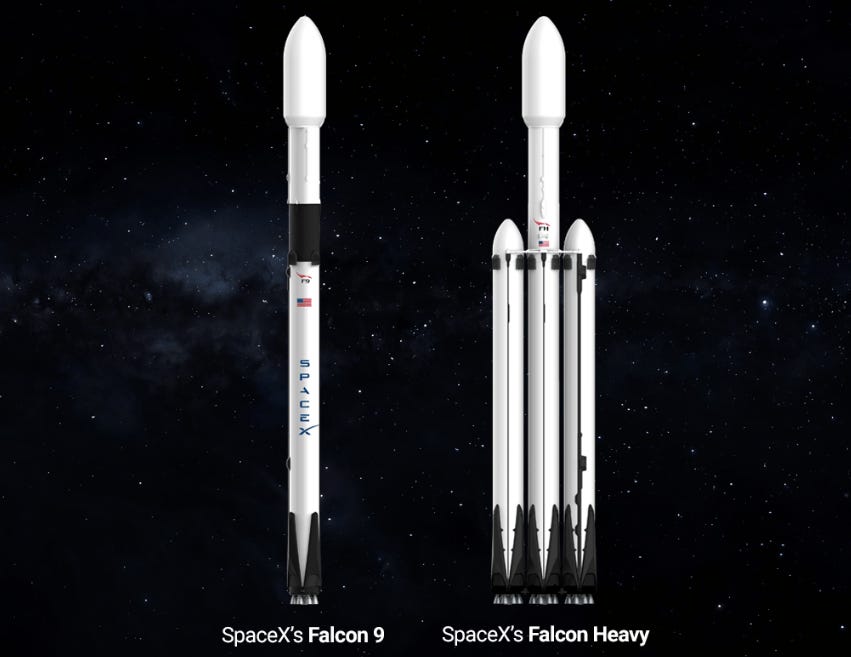
This is very much the SpaceX way - more changes to the design beget more changes in manufacturing beget more money and time spent to launch. The best part is no part, as they say.
SpaceX has launched 13 Falcon Heavies, with a 100% success rate. Most recently when it lofted the Nancy Grace Roman Space Telescope off-world late last month. Combined with the news that SpaceX will be putting Starlink launches from Florida on hold (!!!) and prioritizing getting Starship operational to launch their bigger, better Starlink V3s, the titular question has been floating around:
Why don’t they launch Starlink on Falcon Heavy?
There’s a few hiccups. Let’s go through them one-by-one:
The Mass Problem:
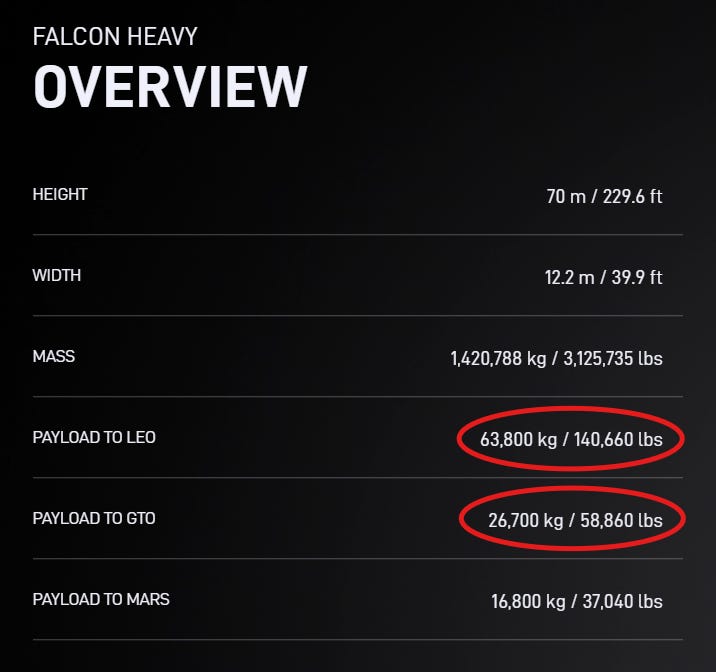
On SpaceX’s website, they quote that they can place ~140,000 pounds of payload in Low Earth Orbit (LEO) and ~59,000 pounds in Geostationary Transfer Orbit (GTO). Unfortunately these numbers have never been demonstrated, and without a major structural overhaul to the rocket’s payload interface, these numbers are vapor.
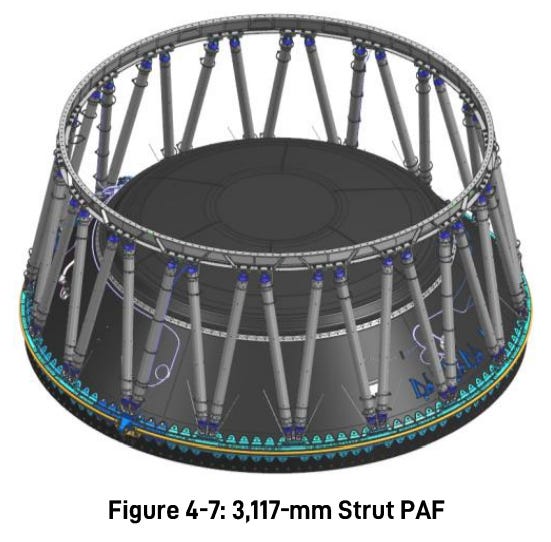
The Payload Attach Fitting (PAF) is the structural interface that mounts your payload to the body of the rocket. The beefiest PAF that Falcon offers is its 3,117-mm variant with added struts. This is for “heavy to ultra-heavy payloads” and “payloads requiring additional capability,” per the manual.
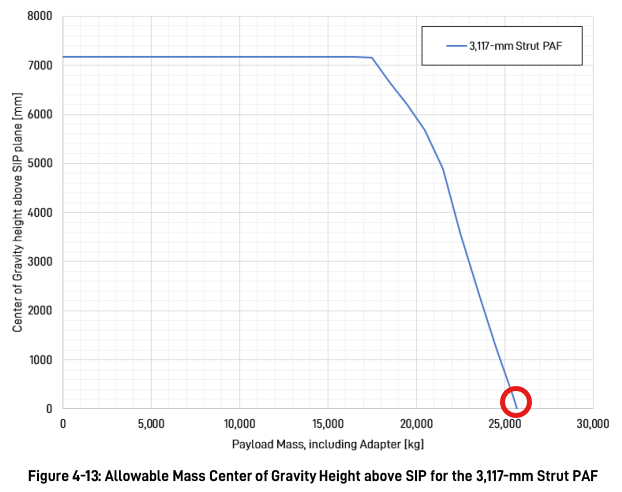
This figure illustrates the limitations of the fitting. Your payload must comply with these limitations, lest something very, very bad happen. Note that this chart measures the allowable payload mass (including the mass of the adapter!), relative to the height of the payload’s center of mass.
At the fictional best-case scenario, where the payload adapter has 0 mass and your spacecraft’s center of mass is right at the interface plane (impossible for a batch of Starlink V3s, or anything worth launching on this fitting), this fitting can handle about 26,000kg (~57,000 pounds).
The NASA classification for a heavy-lift launch vehicle is one that can lift 44,000 to 110,000 pounds to low Earth orbit. It may be on a technicality, but Falcon Heavy makes the cut!
So even in the ideal world, with massless aluminum and paper thin spacecraft and spherical cows, Falcon Heavy falls short of its 140,000lb to LEO, 59,000lb to GTO claims.
SpaceX can always implement structural supports to reinforce this fitting, but again, that’s more time and money. And the returns diminish quick. Added structural support is more mass that your rocket needs to lift, which can throttle its performance significantly and becomes a very slippery slope.
Why do all that retrofitting when, as a company, SpaceX has faith in the Starship program? It might make sense if mass was the only issue, but alas. No such luck.
The Volume Problem:
The Falcon User’s Guide is the end-all-be-all source of information for all things Falcon. As an enthusiast, engineer, and writer, I couldn’t ask for a better resource. More companies could learn from SpaceX’s operational transparency.
But I digress! Our rocket Magna Carta mentions that the 3,117-mm strut PAF we would use for this mission requires the use of Falcon’s extended fairing.
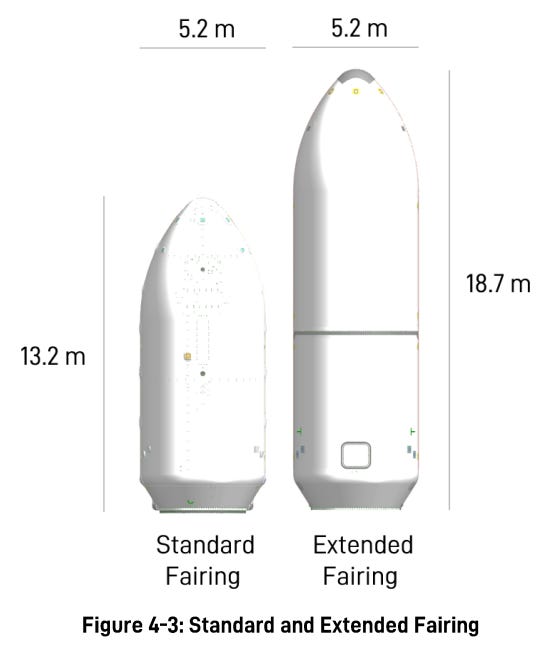
This extended fairing is 5.2 meters longer, but -critically- no wider. For Starlink V3, we need the wideness.
The V3 satellites are designed specifically to be launched from Starship. In fact, the V2s were as well, until SpaceX pivoted to continue building up the constellation while Starship development stalled, creating the “V2 mini” spacecraft.
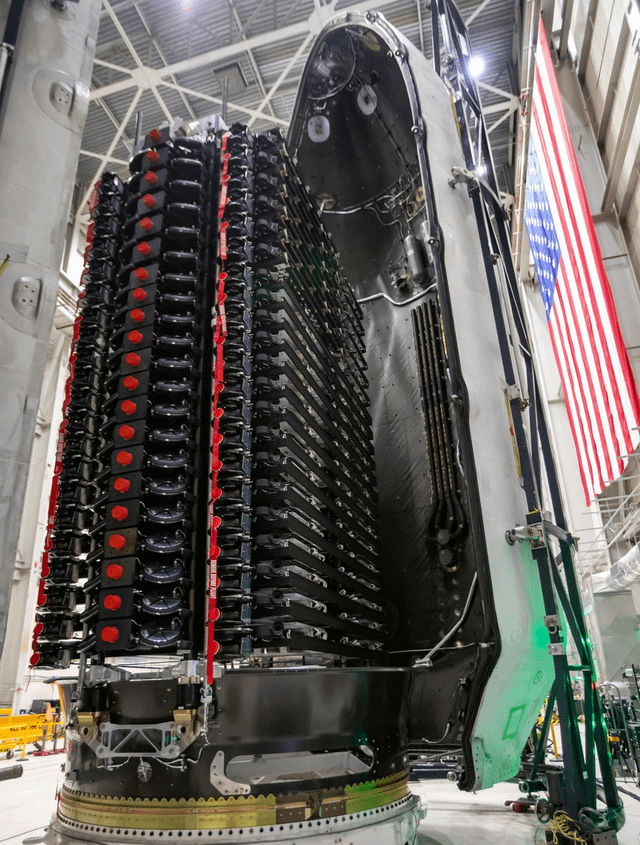
As you can see, even the V2 Minis are so wide that they can only be stacked up to the height before the fairing shape begins to curve. We call that curved-to-a-point shape the fairing ogive (pronounced oh-jive).
Now here is the size of V3 in comparison to V2 (not V2 Mini):
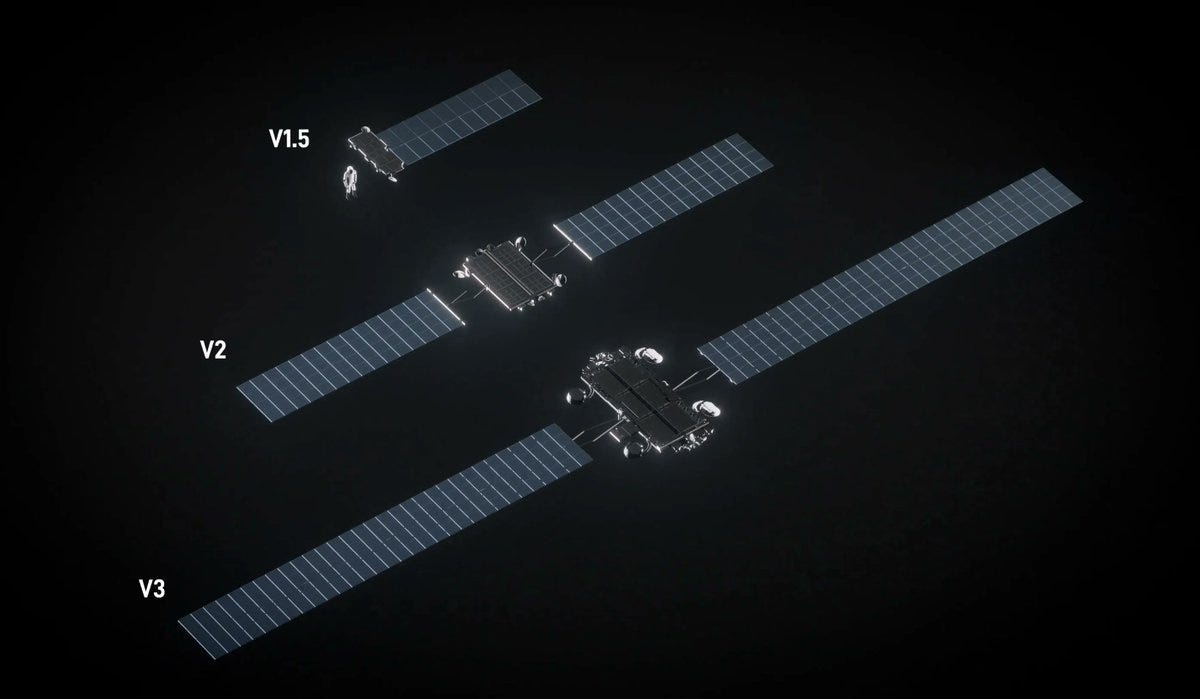
With the solar panels retracted while the satellites are stowed, the size difference remains astronomical. The pictures do all the talking, the point is moot, I am obsolete.
In contrast to our mass constraints, this may be a category where no amount of engineering could overcome the problem. Even a new Falcon fairing optimized for the width of Starlink V3 sats would be colossal and bulbous - generating structural, aerodynamic, and manufacturing implications that will cost time and money in an industry where efficiency is the name of the game. If they even proved possible.
More likely would be SpaceX pivoting again and making a Starlink V3 Mini, but again that presents costs to adapt the satellites, investing time and money into developing a rocket program that is no longer the company’s focus. SpaceX proves time and time again that their business goals are centered on (and dependent on) the success Starship.
The Reuse Problem:
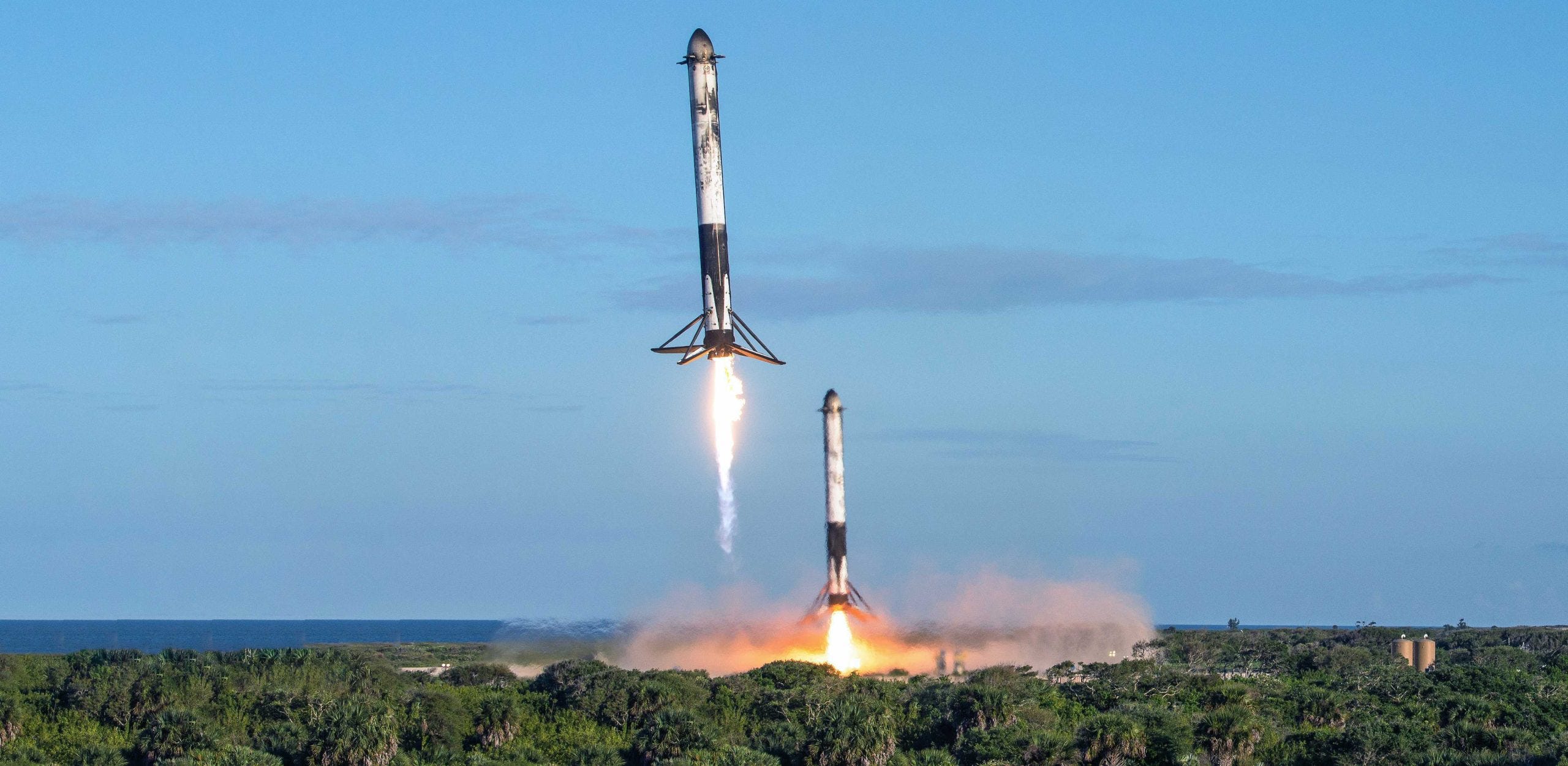
One last nail in the coffin: Falcon Heavy is a logistical pain in the butt to reuse.
LC-39A is the only launchpad in the world equipped to launch Falcon Heavy, and it’s located here in sunny Cape Canaveral, Florida. In their East Coast fleet, SpaceX has two droneships to support Falcon booster landings. But Falcon Heavy has three boosters.
Which means the two side boosters must return to the launch site (pictured above) or the central booster needs to be expended. It takes a lot of fuel to bring your boosters home, so the first option severely limits your potential payload mass and the height of your orbit. If SpaceX had for some reason gone through the strengthening and widening of their FH payload accommodations to fit a load of upgraded Starlinks, they’d now be limited in the thrust department.
Option two is to ditch the core booster at the bottom of the ocean. This is what all Falcon Heavy mission profiles -except one- have demanded. This obviously bottlenecks how quickly you can launch again, because you need to build a new booster for every single launch and reinforce it for heavy-launch forces. This is impractical for the wallet and the schedule.
Interestingly, the one time a Falcon Heavy core booster did come back to land on a barge, it tipped over shortly after.
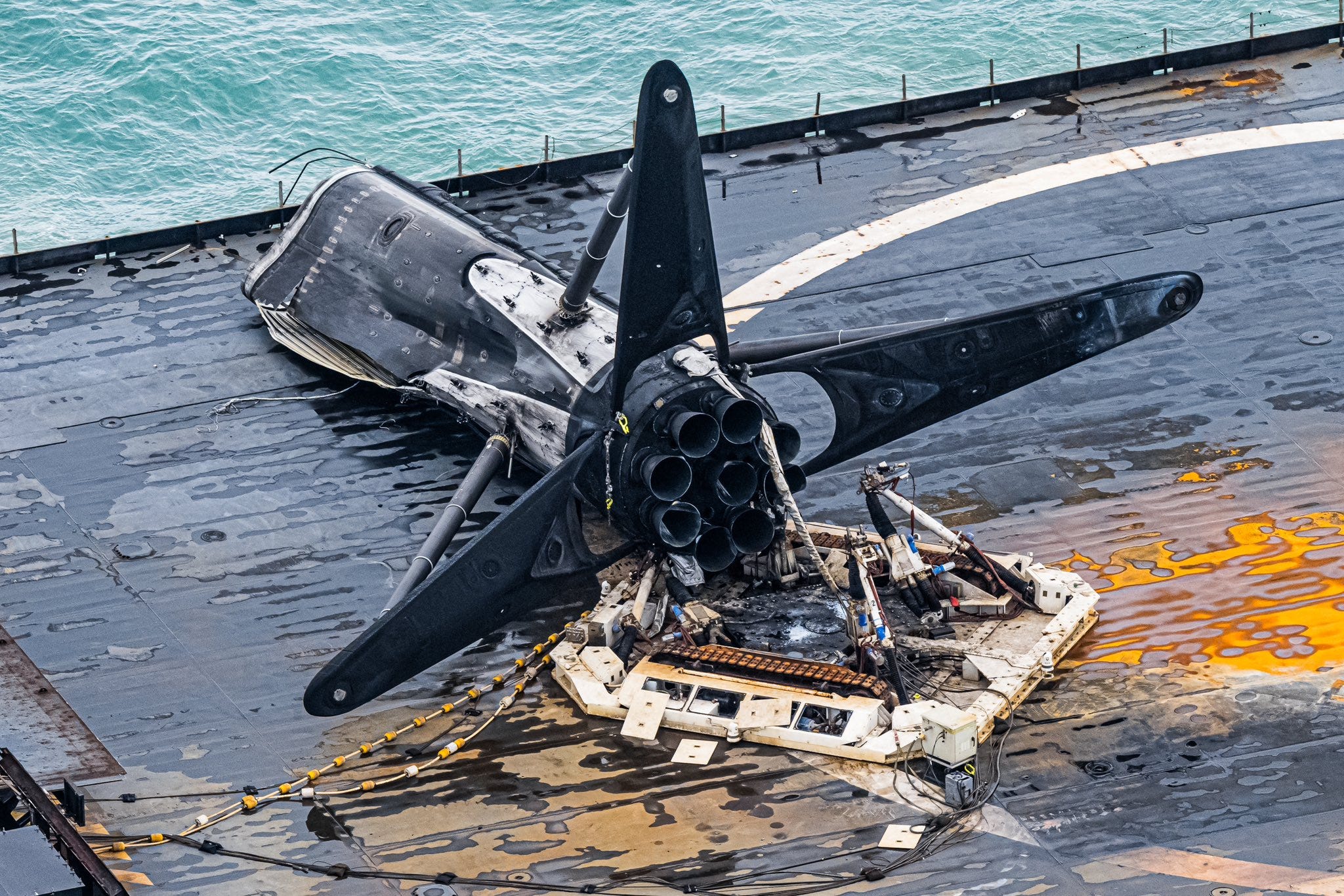
When a Falcon booster lands on the barge, a giant roomba rolls under it and grabs it from below. This system is called the Octagrabber, and its only job is to be heavy. This thing is covered in weights, so by connecting to the bottom of the booster it lowers the center of mass of the assembly. This makes the booster a lot less likely to tip.
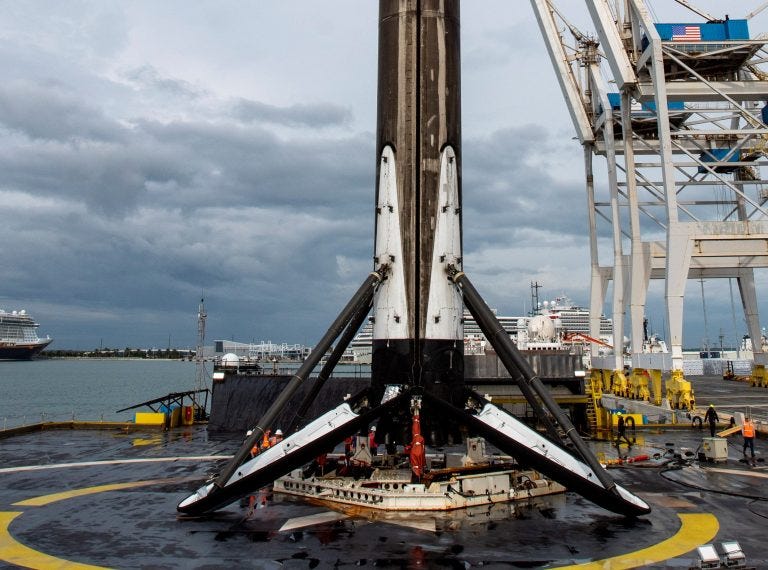
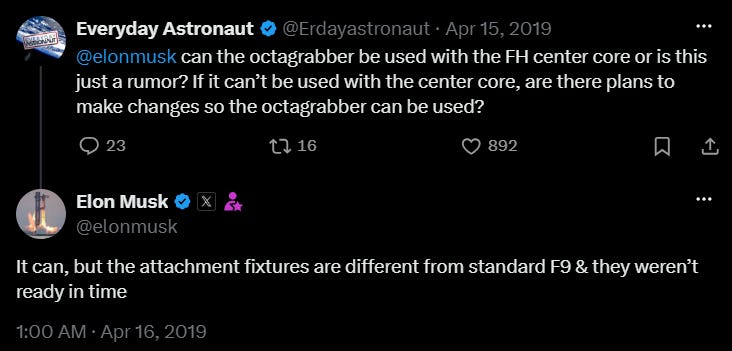
However, Elon Musk confirmed in a tweet after the incident that the hardware required to make the Octagrabber compatible with the FH booster weren’t ready. The plan for that landing was to have marine personnel board the barge and tie the booster down manually, but the seas were too rough and it was unsafe to board.
So the core booster landing option requires retrofitting ground hardware to be compatible with FH. More cost, more testing, more time. In this case, it cost the whole booster.
In April of this year, SpaceX’s VP of launch stated that one of SpaceX’s East coast landing droneships “will join the ‘You’ll Thank Me Later’ ship to support Starship and SupeHeavy transport from Starbase to the Cape.”
He added “We have a plan for any double down range Falcon Heavy missions,” but this focus on Starship operations will inevitably make Falcon Heavy recovery even more of a logistical challenge.
The Starlink swarm is built on quantity, quantity, quantity; which is why having the reliable and rapidly reusable Falcon 9 vehicle has been key to its success. Even if SpaceX could retrofit an FH to carry significantly more satellites than an F9, it could still never compete on reusability.
What It All Means
For customers like NASA and the DOD, these limitations don’t matter. These organizations use Falcon Heavy to launch relatively small and light payloads into hard-to-reach orbits. And they can afford to pay for mission architectures that expend the boosters and central rocket core, if need be. For that purpose, Falcon Heavy is a great option.
But for massive Starlink clusters, Falcon Heavy presents strict mass, volume, and reusability constraints that make the idea a bit of a non-starter. At the intersection between engineering and business there are a deluge of trades, determining the value, the cost, the risk, and the probability of a program’s success. When Falcon 9 can launch Starlink swarms as-is with rapid reusability, and when larger Starlink satellites are… well, larger, adapting Falcon Heavy for high-volume Starlink launches just doesn’t make sense.
The juice ain’t worth the squeeze.
Especially when you consider the following:
On Friday, July 24, 2026, Starship deployed 20 Starlink V3 satellites from its on-board “Pez Dispenser” system. It worked exactly as advertised. This set wasn’t deployed in a complete orbit, so the satellites re-entered the atmosphere, presumably burning up in the process. However, Starship Flight 14 is set to be the vehicle’s first ever orbital insertion and will deploy another 20 Starlink satellites, this time to remain in orbit. And it’s scheduled for this coming Friday morning!
Starship is designed to be able to handle 60 Starlink V3 satellites, which would add a proposed 61,000 Gbps of network bandwidth in a single launch. In contrast, a Falcon 9 carrying its full load of 27 Starlink V2 satellites adds just 2,600 Gbps. Pop that in your abacus and you’ll find that in terms of data transfer capacity, one Starship launch equals more than 23 F9 launches.
Knowing that, it’s no wonder why SpaceX is going so hard on developing Starship. Let’s wrap this up.
If you want to launch a reasonably sized spacecraft to somewhere far out, consider the Falcon Heavy. But if you want a heavy-lift system that can launch what FH claims, you’re gonna need a bigger boat.
Interesting Links and Papers
A new Executive Order directs NASA to stand up the United States Space Academy, a proposed NASA-led federal academy combining technical education with leadership development and service obligations.
SpaceX is dialing back Falcon 9 flight rates, and some satellite companies still have an appetite for boutique launch services — dedicated small- and medium-lift launches remain worth the premium for operators who need exact orbits and timelines. As we noted in our inaugural edition, dedicated launch is a budget line that keeps growing, not shrinking.
A new NASA office is set to consolidate launch procurements across the agency, streamlining how missions buy rides to space and potentially reshaping how small launch providers compete for government work.
Europe just gained its first fully commercial orbital launch capability: Germany’s Isar Aerospace reached orbit on its second Spectrum attempt, delivering CubeSats from Andøya Spaceport in Norway - the first pure commercial European launch success and a timely counterweight to the Falcon 9 slowdown.
Optical Flashes from Beam-Driven Light Sails with the Roman, Rubin and Euclid Observatories (Guillochon & Loeb): a feasibility study for detecting the photon exhaust of interstellar light sails as brief flashes, turning three flagship observatories into a Beamed Energy Propulsion detection network. I love a situation where the ground hardware is ready before the orbital hardware.
This Week’s Launches
SpaceX Falcon 9 | O3b mPOWER 11, 12 & 13
Target Date / Location: Sunday, September 13, 2026 — 2:49 PM EDT (18:49 UTC) | Cape Canaveral SFS (SLC-40), FL, USA
Details: First-ever launch of three mPOWER satellites (5,100 kg total) for SES’s O3b Networks. The final mission of the constellation, delivering 3 payloads to Medium Earth Orbit.
Avio Vega-C | Sentinel-3C & FLEX
Target Date / Location: Monday, September 14, 2026 — 9:21 PM EDT (Tue, 01:21 UTC) | Guiana Space Centre (ELV), French Guiana
Details: ESA’s Copernicus ocean-and-land monitoring satellite (Sentinel-3C) rideshare with the Fluorescence Explorer (FLEX) photosynthetic mapping mission, to Sun-synchronous orbit at 820 km.
Landspace ZhuQue-2E Block 2 | Unknown Payload
Target Date / Location: Tuesday, September 15, 2026 — 2:25 AM EDT (06:25 UTC) | Jiuquan Satellite Launch Center, China
Details: Methalox smallsat launcher from China’s Landspace, on an unannounced payload to low Earth orbit.
Orienspace Gravity 1 | Unknown Payload
Target Date / Location: Tuesday, September 15, 2026 — 5:50 PM EDT (21:50 UTC) | Haiyang Oriental Spaceport, China
Details: Solid-fueled medium-lift rocket from Orienspace, a rising Chinese commercial launcher, delivering an undisclosed payload to orbit.
Target Date / Location: Tuesday, September 15, 2026 — 9:00 PM EDT (Wed, 01:00 UTC) | Vandenberg SFB, CA, USA
Details: U.S. Space Force national security payload, riding a Falcon 9 from the West Coast.
Roscosmos Soyuz 2.1b | Progress MS-35 (96P)
Target Date / Location: Wednesday, September 16, 2026 — 9:33 AM EDT (13:33 UTC) | Baikonur Cosmodrome (Site 31/6), Kazakhstan
Details: Uncrewed logistics spacecraft delivering propellant, pressurized cargo, and science experiments to the International Space Station.
CASC Long March 12 | Unknown Payload
Target Date / Location: Wednesday, September 16, 2026 — 8:25 PM EDT (Thu, 00:25 UTC) | Wenchang Space Launch Site, China
Details: Medium-lift cryogenic launcher from China’s state industry, deploying an undisclosed satellite batch.
ExPace Kuaizhou 11 | Unknown Payload
Target Date / Location: Wednesday, September 16, 2026 — 10:31 PM EDT (Thu, 02:31 UTC) | Jiuquan Satellite Launch Center, China
Details: Solid-fueled smallsat launcher operated by ExPace, a CASIC subsidiary, flying an unannounced payload.
SpaceX Starship Flight 14 | Starship-Super Heavy v3
Target Date / Location: Friday, September 18, 2026 — 8:15 AM EDT (12:15 UTC) | Starbase, TX, USA
Details: The next integrated Starship test flight from Boca Chica, continuing the flight test campaign for the world’s largest rocket.
CASC Long March 2D | Unknown Payload
Target Date / Location: Saturday, September 19, 2026 — 6:43 AM EDT (10:43 UTC) | Taiyuan Satellite Launch Center, China
Details: Legacy small-to-medium launcher deploying an undisclosed payload, from China’s northern launch site.
SpaceX Falcon 9 | Starlink Group 15-27
Target Date / Location: Saturday, September 19, 2026 — 9:47 PM EDT (Sun, 01:47 UTC) | Vandenberg SFB, CA, USA
Details: Starlink.
Open Procurements & Grants
NASA SBIR/STTR FY2026–2027 Rolling BAA — NASA has transitioned its SBIR/STTR program from a single annual drop to an active, rolling Broad Agency Announcement (valid through Sept 2027), seeking Phase I & II proposals across cryogenic fluid management, lunar surface mobility, and in-space autonomous assembly. (Continuous Rolling Submissions)
SpaceWERX / DAF SBIR: 26.BX & 26.TX Release 6 — SpaceWERX has opened pre-release for its Release 6 topics, with submissions opening September 23. Includes SBIR & STTR, Direct-to-Phase II & Phase I, and 2 modernization priority tech areas for dual-use space systems. (Pre-release open now; submissions open Sept 23, 2026)
SpaceWERX Specific Topic 26.BX Release 5 — SpaceWERX is actively accepting proposals through the DoD SBIR portal for Specific Topic Release 5, covering tactical space domain awareness, on-orbit servicing, and cyber resilience for space assets. (Open for submissions now)
NASA ROSES-2026: Astrophysics Research and Analysis (APRA) — NASA Science Mission Directorate is seeking proposals for suborbital payloads, detector development, and laboratory astrophysics instruments supporting future space observatories. (NOIs due September 18, 2026; Proposals due October 23, 2026)
Space Job Openings
Full-Time
Planet Labs is seeking a Flight Dynamics Engineer, Orbits R&D located in San Francisco, CA.
Relativity Space is seeking an Aerothermal Engineer II located in Long Beach, CA.
Rocket Lab is seeking an Avionics Automation Test Engineer II located in Long Beach, CA.
SpaceX is seeking an Aerodynamics Engineer (Starship) located in Starbase, TX.
Internships & Co-ops
Rocket Lab is seeking a Development Engineering Intern — Neutron Thermal Protection Systems located in Auckland, NZ.
SpaceX is seeking a Summer 2027 Engineering Internship/Co-op located at a flexible SpaceX site.
Why Altru Space?
Altru Space is a technical deep dive on the space industry’s top stories, delivered weekly. We emphasize engineering excellence and sustainability to understand how we can make our world a better place and explore the final frontier at the same time.